
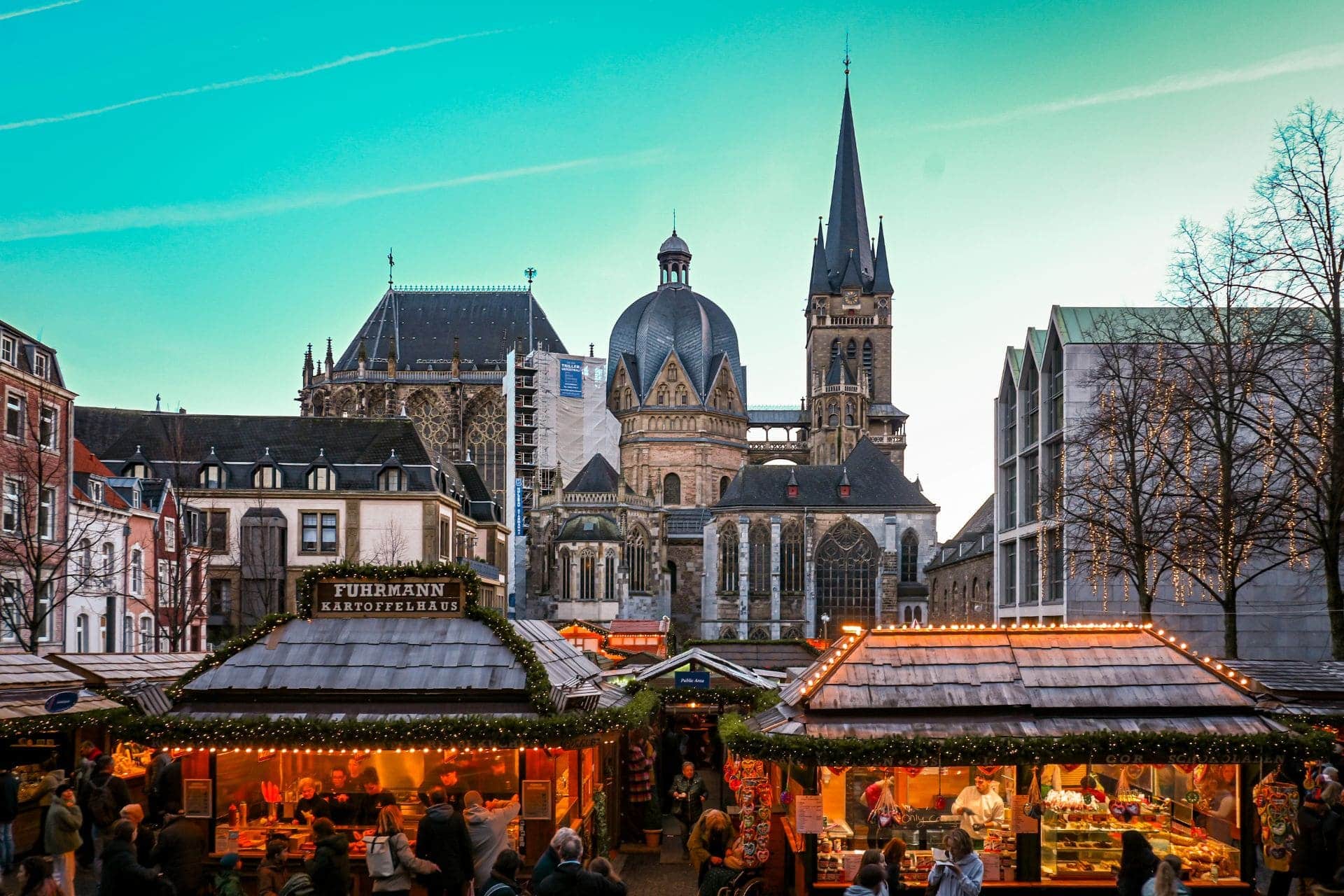
Aachen Cathedral is one of the few buildings in Europe that has retained its political and spiritual significance for more than a millennium. When you enter the cathedral, you experience a place where power, faith, and European history converge. That is why it was the first German building the first German building to be included in the UNESCO World Heritage List in 1978. Its significance is revealed in the interplay of architecture, religious function, and political symbolism.
Aachen Cathedral UNESCO World Heritage Site
UNESCO status: since 1978
Location: Aachen, North Rhine-Westphalia
Type of World Heritage Site: cultural heritage
UNESCO criteria:
(i) Masterpiece of human creativity
The Palatine Chapel of Aachen Cathedral is a key architectural work of the Carolingian period that combines ancient and Byzantine building ideas.
(ii) Significant exchange of cultural values
The cathedral is evidence of the deliberate recourse to the Roman heritage and the cultural exchange between the Mediterranean region and northern European architecture. Aachen thus becomes a place of mediation between antiquity and the Middle Ages.
(iv) Outstanding example of a building type
As a Carolingian palatine chapel, the cathedral is exemplary of a new form of sacred architecture that combined rule, liturgy and spatial concept and served as a model for later church buildings.
(vi) Direct link to events of universal significance
The construction of the cathedral symbolizes Charlemagne's claim to a spiritual and political renewal of the West. With his burial in 814 and its centuries-long function as the coronation church of the Roman-German kings and emperors, Aachen became a central place of remembrance and power in Europe. The Cathedral Treasury preserves artefacts of exceptional archaeological, aesthetic and historical value that make this significance visible to this day.
Aachen Cathedral is of central importance to European history. It combines architecture, claim to power, religious practice and cultural tradition to form an exceptionally dense historical ensemble - and is thus exemplary of Europe's early self-image.
You can find more exciting travel destinations in Germany in my overview Destination Germany - 100+ selected places by federal state.
History and Architecture of Aachen Cathedral
The core of Aachen Cathedral is the Palatinate Chapel, built around 795 under Charlemagne.. Aachen was Charlemagne's preferred residence. After his death in 814, he was buried there. The central building is clearly based on late antique and Byzantine models, in particular San Vitale in Ravenna, which Karl presumably knew himself.
In the Middle Ages, Aachen developed into one of the most important political centers of the empire. Between 936 and 1531 , 30 Roman-German kings were crowned here, underlining the outstanding position of the city and its cathedral.
Today's cathedral is the result of many construction phases over more than 1,200 years: Gothic extensions, Baroque furnishings, and historicist additions surround the Carolingian palace chapel, making Aachen Cathedral a unique architectural ensemble.
Selected Highlights in the Cathedral
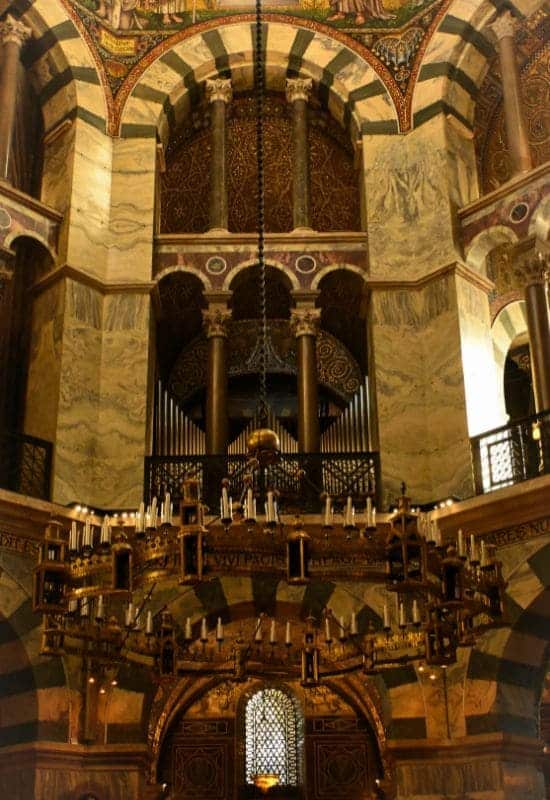
1. The Octagon (Palatine Chapel)
The central room of the cathedral is designed as an octagon, and is surrounded by a sixteen-sided gallery. This spatial concept, which is unusual for the Carolingian period north of the Alps, testifies to a high level of architectural and engineering expertise. The complex draws on late antique and Byzantine models such as San Vitale in Ravenna , but translates them into a clearly structured, monumental form. The architecture illustrates Charlemagne's claim to stand in the tradition of the Roman emperors, and at the same time, to establish a new order for the Christian West.
Charlemagne - Ruler and Shaper of Europe
Life data: April 2, 748 to January 28, 814
Title: King of the Franks, Roman Emperor from 800
Charlemagne shaped the political and cultural order of Europe like almost no other ruler of the early Middle Ages. He made Aachen his preferred palace because the location was suitable as a permanent seat of power: conveniently situated, with an existing royal palace and prized warm springs. With the construction of the palace complex and the Palatine Chapel, Charlemagne created a representative center of his power here, deliberately drawing on ancient and Byzantine models.
Aachen was not a capital in the modern sense, but it developed into a central place of rule, administration, and representation. Charlemagne held court here, received envoys, and was buried in the Palatine Chapel after his death in 814.
One of Charlemagne's lasting achievements was the Carolingian educational reform. He promoted schools at monasteries and bishoprics, had ancient and Christian texts systematically collected and copied, thereby strengthening education, literacy, and administration in the empire. These reforms formed the basis for the cultural development of medieval Europe.
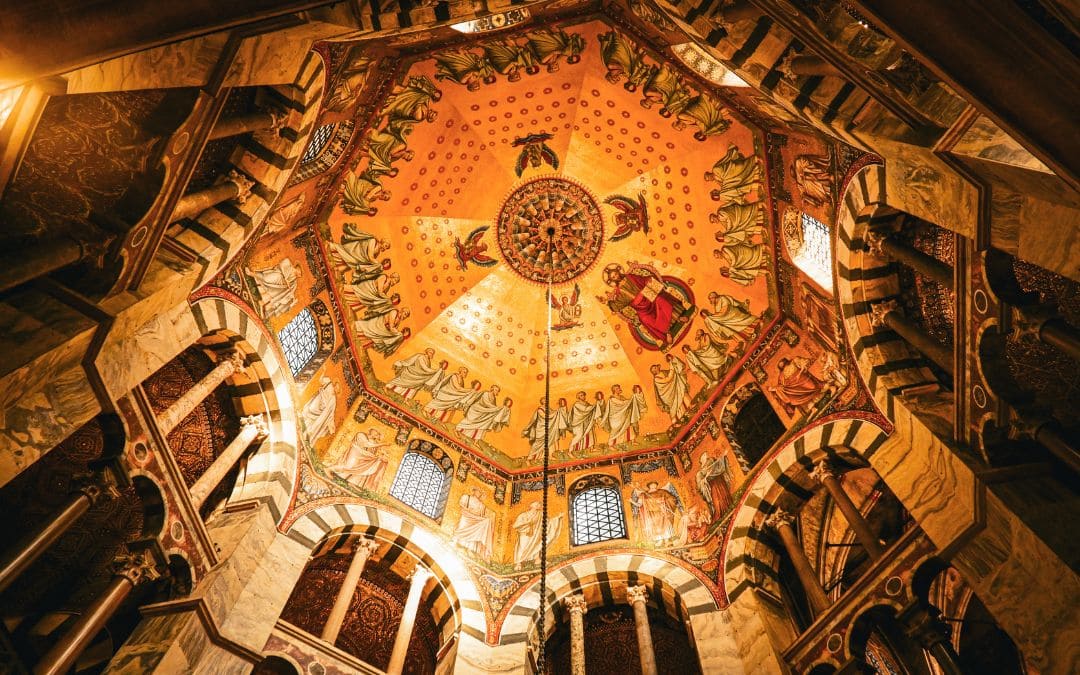
2. The Dome Mosaic
The current dome mosaic dates from the 19th century and replaces older versions. It shows Christ as the ruler of the world, surrounded by the apocalyptic beings and the 24 elders of Revelation. Although it is not part of the original Carolingian decoration, the imagery consistently follows the medieval concept of divinely legitimized rule. The dome thus reinforces the sacred and political message of the central room.
3. The Barbarossa Chandelier
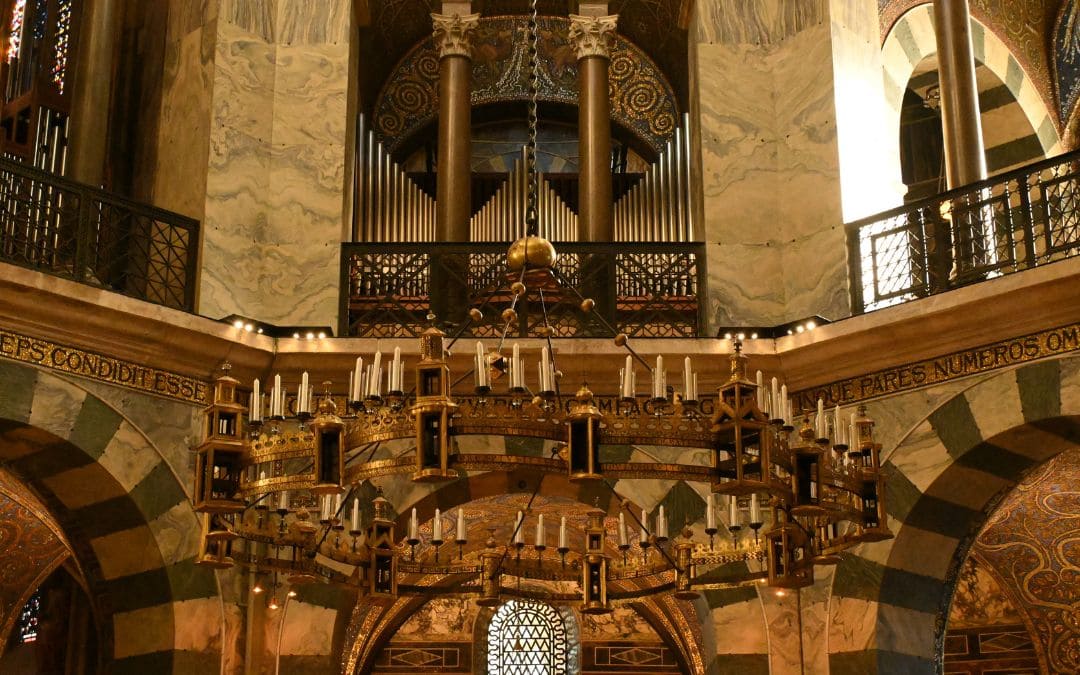
The Barbarossa Chandelier, made of gilded copper, was donated around 1165 by Emperor Frederick I Barbarossa in honor of the Virgin Mary and Charlemagne. With a diameter of around 4 meters and a weight of around 300 kilograms, it is one of the largest surviving wheel chandeliers of the Middle Ages. Its wreath with twelve towers and twelve gates symbolizes the Heavenly Jerusalem of the Book of Revelation. The chandelier hangs from a 27-meter-long, hand-forged chain under the dome of the Carolingian octagon. The 48 candles are only lit on high holidays, as the chandelier must be thoroughly cleaned after each use.
4. The Shrine of Mary
The golden Shrine of Mary from the 13th century houses four central textile relics: Mary's dress, Jesus' swaddling clothes, John the Baptist's execution cloth, and Christ's loincloth. These relics made Aachen one of the most important pilgrimage sites in Europe in the Middle Ages. To this day, they shape the religious significance of the cathedral and its role as a spiritual center.
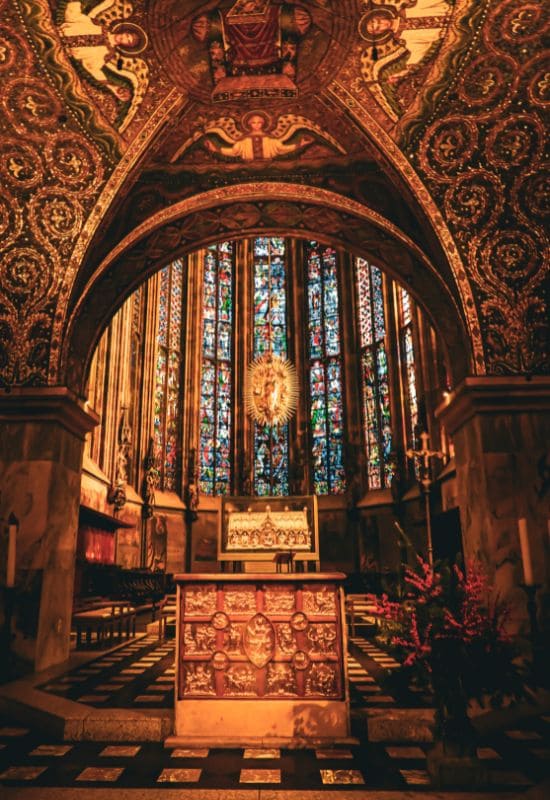
5 The Shrine of Charlemagne
The Shrine of Charlemagne, built between 1215 and 1230, contains the mortal remains of Charlemagne. Its design combines Romanesque forms with early Gothic elements. The pictorial programs and figures depict Charlemagne as a Christian ruler and exemplary king. The shrine illustrates the close connection between historical memory and religious veneration in the Middle Ages.
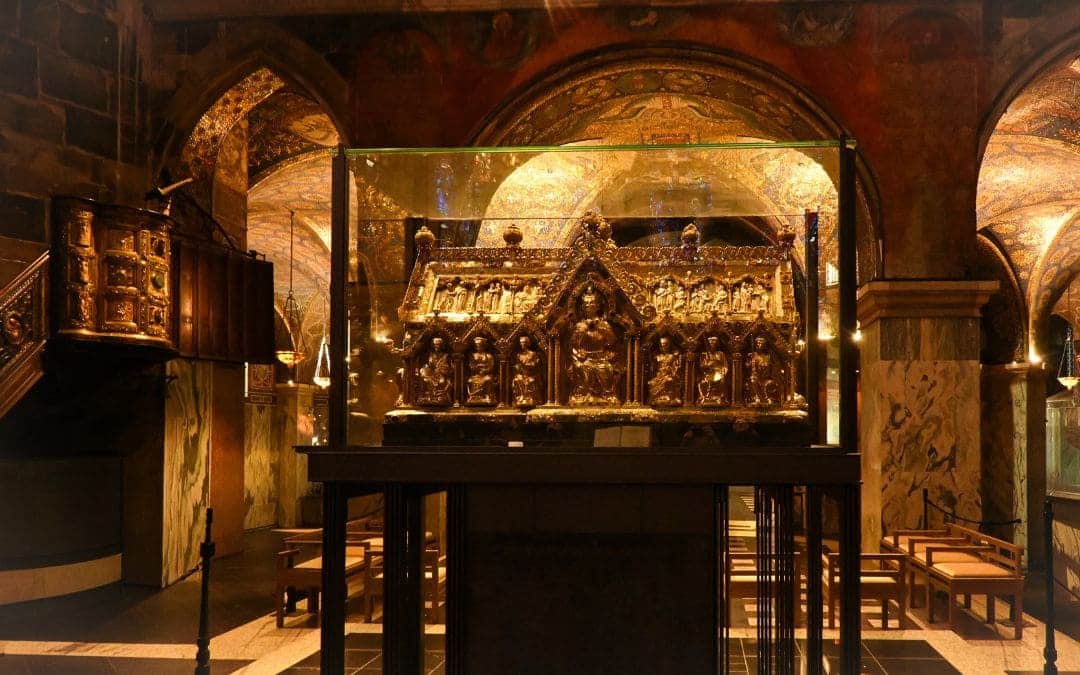
6. The Throne of Charlemagne
The simple marble throne on the west gallery is one of the most important symbols of power from the Middle Ages. It was probably made from ancient spolia on the orders of Charlemagne and served for centuries as the coronation throne of the Roman-German kings. Charlemagne himself was not crowned on this throne, but became king in Noyon in 768 and emperor in Rome in 800. It can be assumed that he sat on this throne during the masses held in the Palatine Chapel.
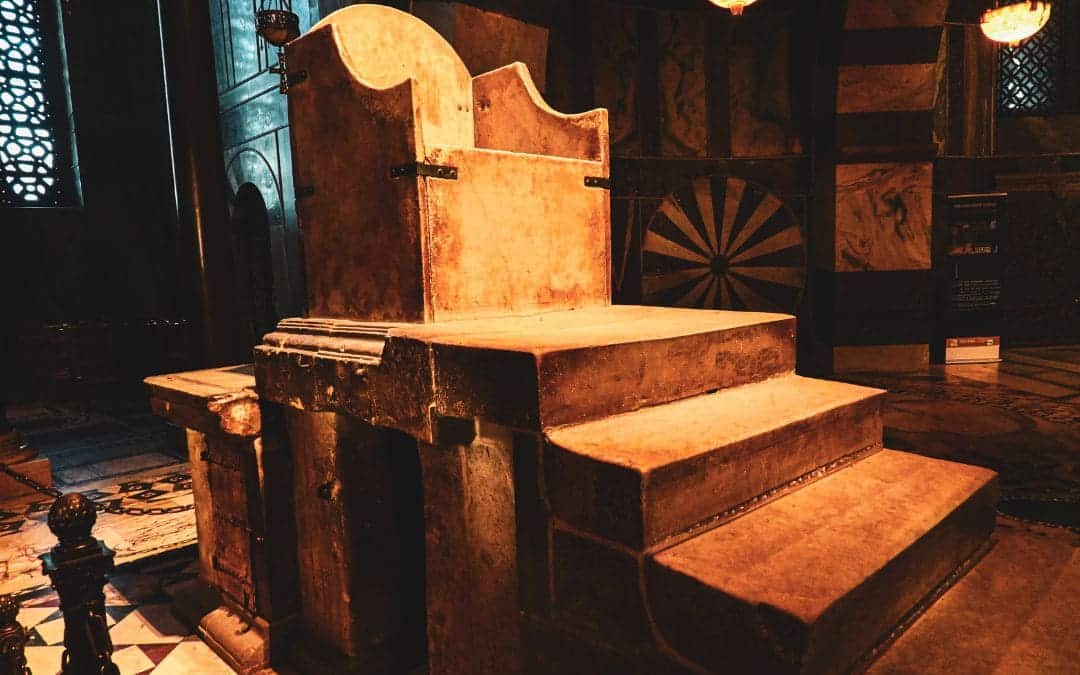
7. The Westwork
The westwork of Aachen Cathedral dates back to the Carolingian period and was part of the original Palatine Chapel complex. It was once preceded by an atrium, which formed the transition from the secular royal hall to the sacred space of the cathedral. Access to the church was spatially and symbolically graded. It combined secular power with religious authority.
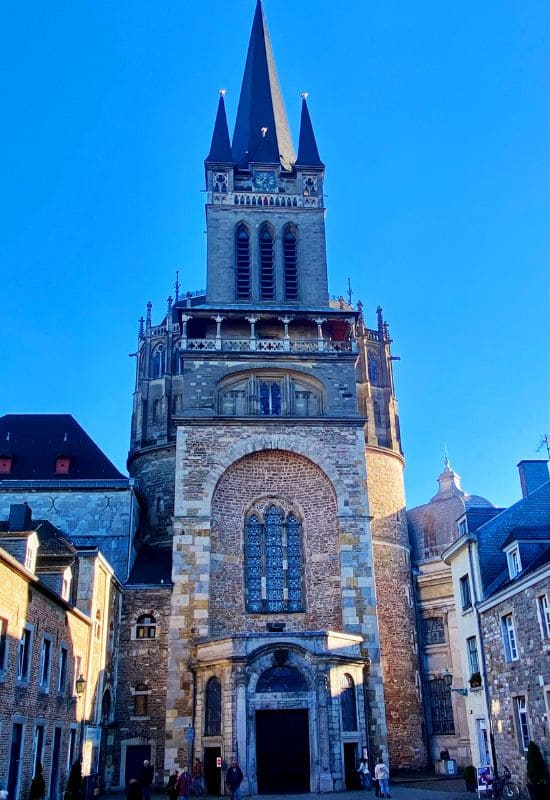
8. The Wolf Door and the Aachen Cathedral Legend
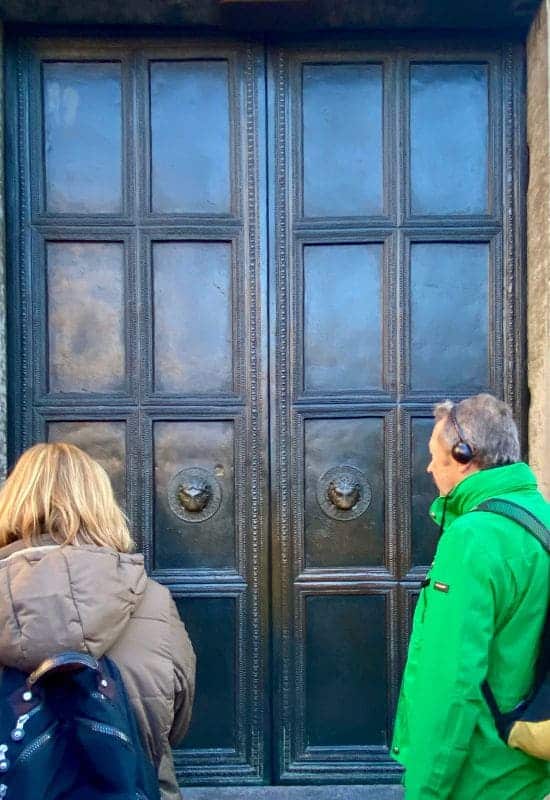
The Wolf Door is one of the oldest bronze doors north of the Alps and is one of the original entrances to the Palatine Chapel. It is associated with the Aachen Cathedral Legend, which is still part of the city's cultural memory today. According to tradition, when the city council ran out of money during the construction of the cathedral, they made a pact with the devil, who was to receive the first soul to enter the cathedral as payment. To deceive him, they let a wolf into the church. When the devil realized he had been tricked, he stormed out of the cathedral in a rage and lost his thumb in the right lion's head door handle. The thickening in the door handle is actually a bronze pin.
9. The Gothic Extensions
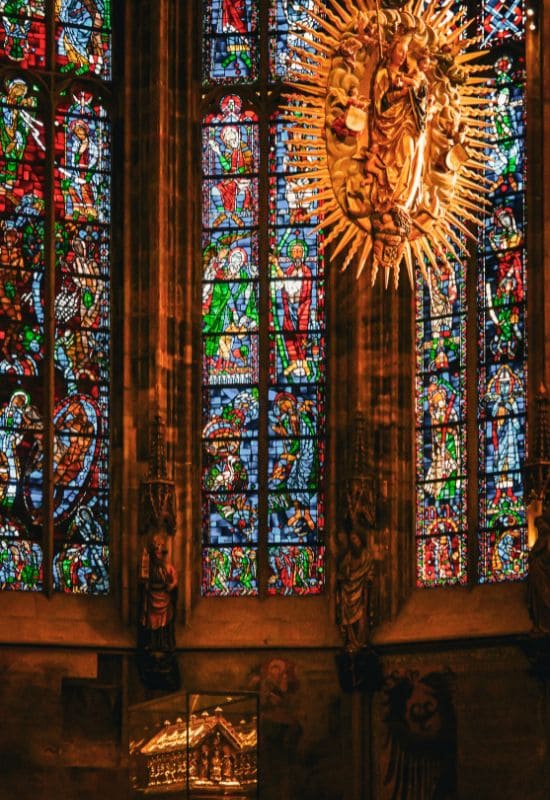
From the 14th century onwards, Gothic chapels were added to the cathedral, most notably the choir hall. It contrasts with the Carolingian core structure and was built to accommodate the growing number of pilgrims. These additions did not fundamentally change the building, but rather complemented it in terms of functionality and interior design. The choir hall has a glass surface area of more than 1,000 square meters and is up to 25 meters high. Because of these huge windows, it is also called the “Glass House of Aachen.” Among other things, you will find the Shrine of Charlemagne there, but it can only be visited as part of a guided tour.
10. The Cathedral Treasure
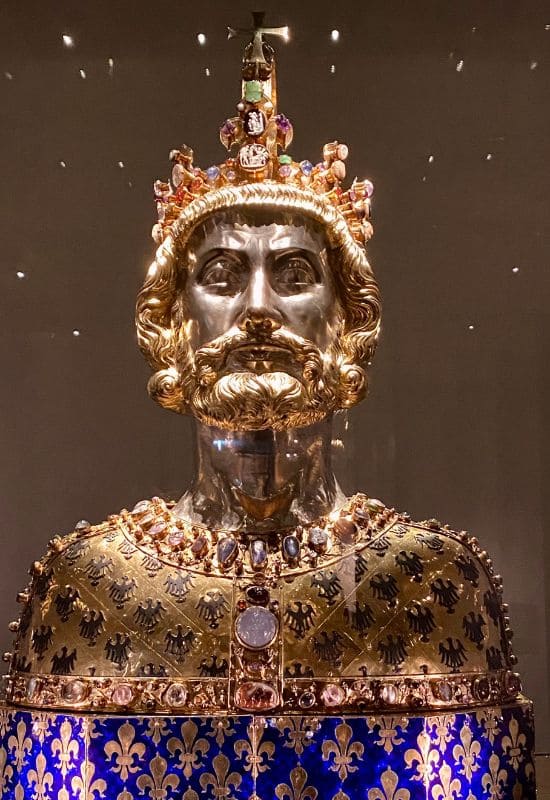
The Aachen Cathedral Treasure is one of the most important church treasures in Europe. It includes liturgical objects, reliquaries and textiles from over a thousand years and documents the continuous use of the cathedral as a spiritual center. A central object is the gilded bust of Charlemagne (around 1350), which contains a skull relic. Its idealized representation has had a decisive influence on the image of Charlemagne as a ruler for centuries. Among the most famous exhibits are the Lothar cross from the 10th century, which is decorated with hundreds of precious stones and was carried at coronations in the cathedral, and the proserpina sarcophagus, in which Charlemagne was originally buried.
Visit to Aachen Cathedral
Address: Domhof 1, 52062 Aachen
The cathedral is generally open to the public, but there is a charge for certain areas such as the cathedral treasury and guided tours. Opening hours, access restrictions, and prices vary depending on the time of day, liturgical events, and season.
For guided tours and for visits to certain areas, an admission ticketis required. This can be purchased at the Dominformation; however, it is recommended to purchase tickets online in advance, as the number of participants is limited. Without a guided tour, central elements such as Charlemagne's throne are not accessible, and Charlemagne's shrine can only be viewed from a distance.
Current opening hours & guided tours: Website of Aachen Cathedral
Getting there & location
Railroad:
Aachen main station, approx. 15 minutes on foot
Car:
Central parking garages near the cathedral; traffic-calmed old town
On foot:
Centrally located in the old town
Conclusion: World Cultural Heritage between Power and Faith
A visit to Aachen Cathedral gains considerable depth when you know what you are looking at. Many parts of the cathedral are not self-evident: Charlemagne's throne on the west gallery is not accessible without a guided tour, and Charlemagne's shrine in the nave can only be seen from a distance. A guided tour brings you up close to these central elements of the cathedral. It also opens up perspectives that are difficult to perceive on your own and places what you see in its historical context.
In this way, you consciously perceive what others only see fleetingly. You are moving in a space that has been used, changed, and interpreted for centuries.
Aachen Cathedral is the first in a series of articles about UNESCO World Heritage Sites in Germany. This series is for travelers who don't just want to tick off sights along the way, but also want to understand the background.
Continue Reading
In my comprehensive overview article on UNESCO World Heritage Sites in Germany you will find all the listed places at a glance - from Aachen Cathedral to lesser-known World Heritage Sites, that are equally worthwhile destinations for a trip or excursion.
Aachen's Christmas market is one of the most beautiful Christmas markets in Germany.Anja from Travel on Toast has written an article with lots of tips on this topic.
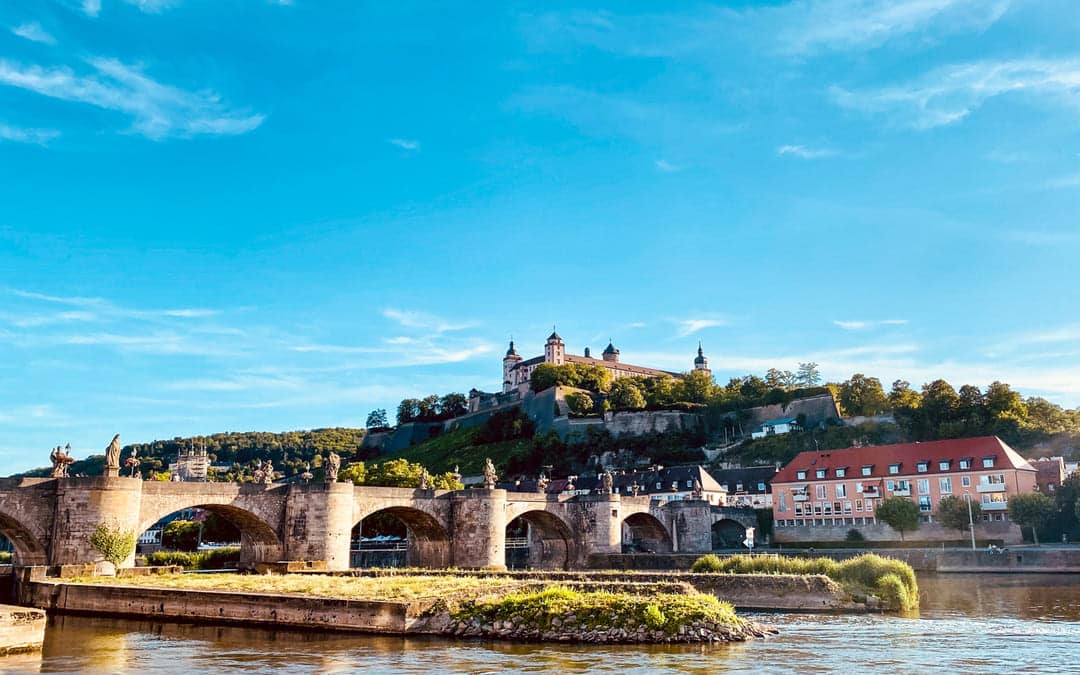
Most of Würzburg's sights are close together and can easily be discovered on foot. The highlights of the old town can be read more
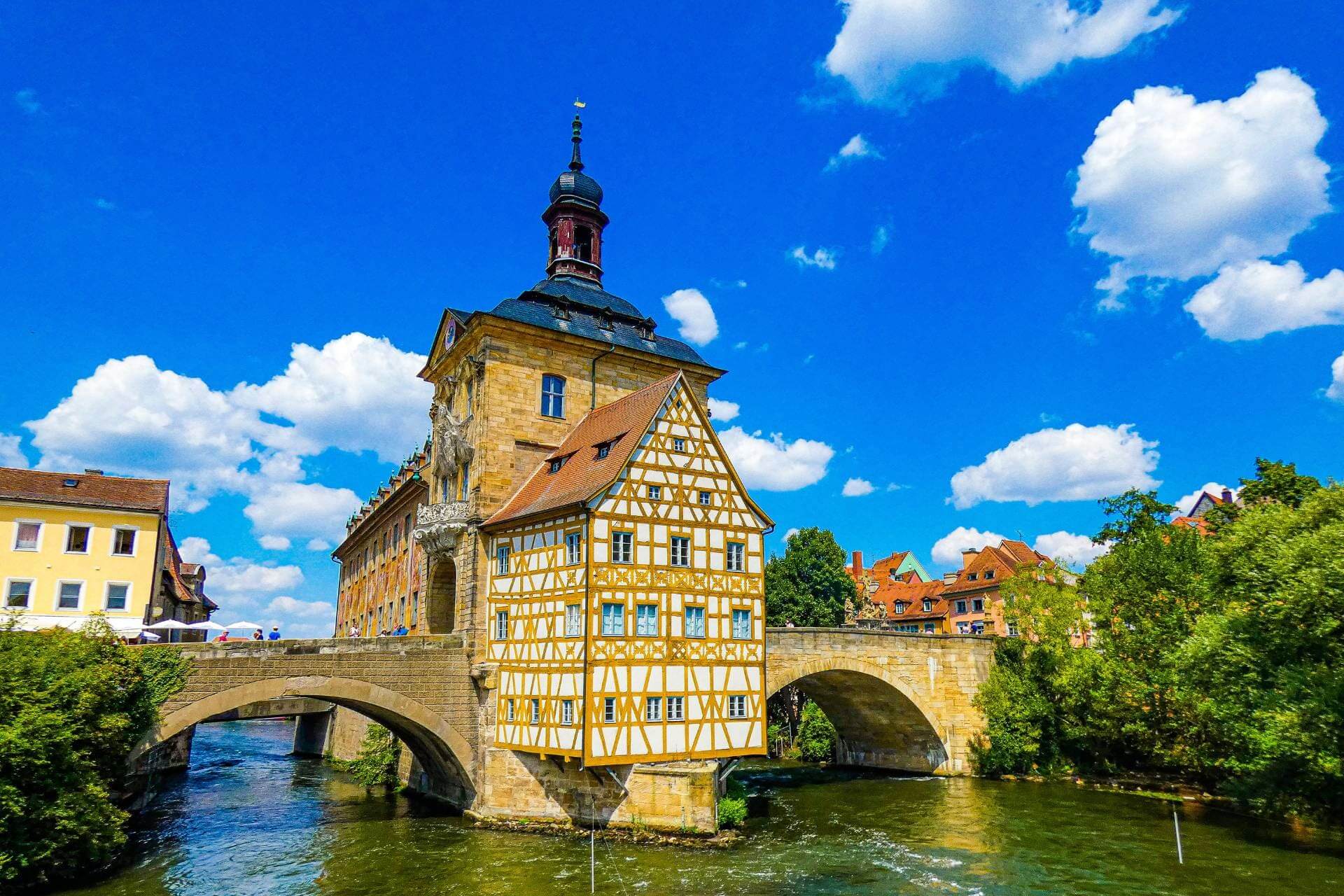
UNESCO World Heritage Sites are places of outstanding universal value, whether for their cultural significance or their unique natural setting. The UNESCO World Heritage List was read more
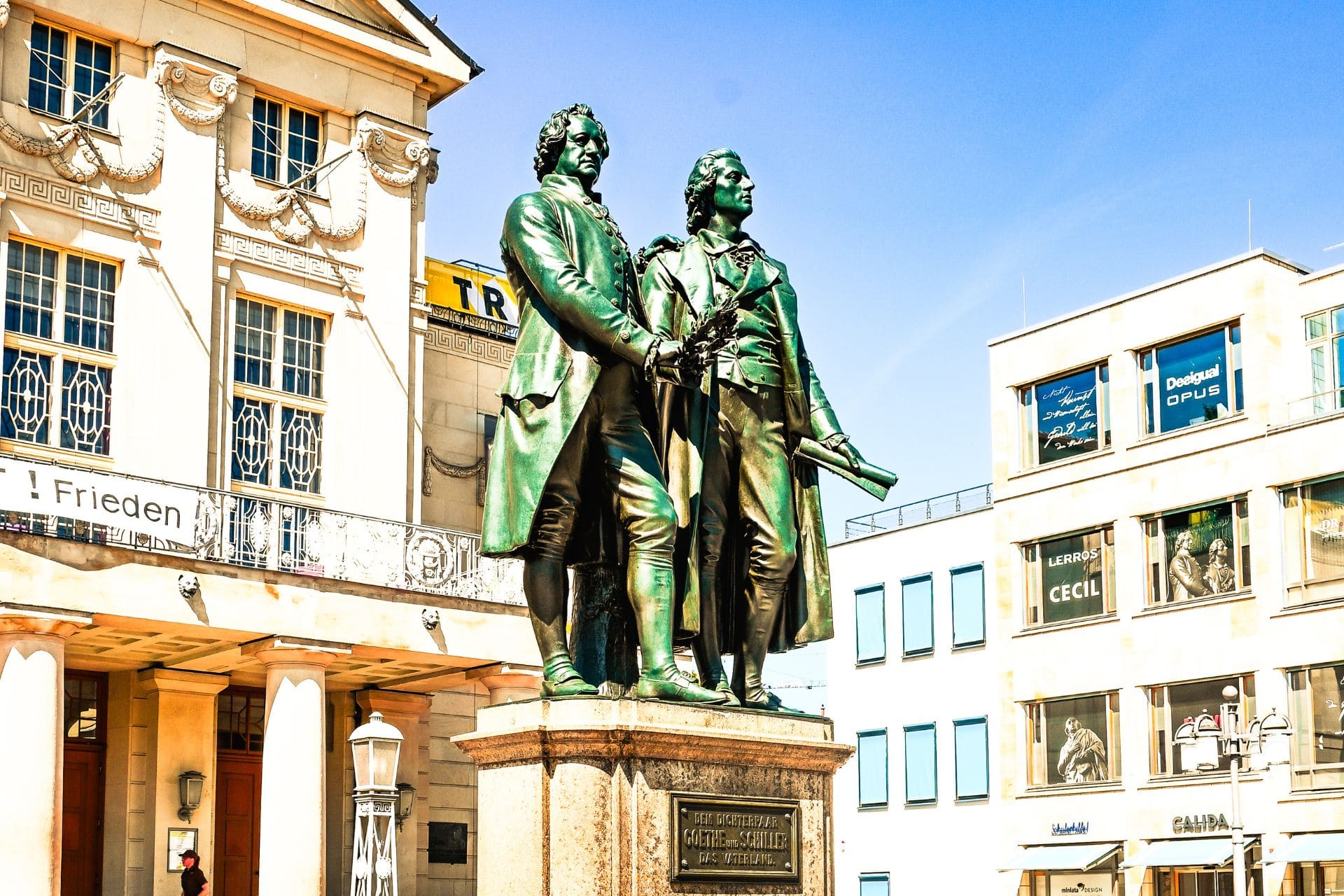
Weimar's sights are in a special field of tension: here lie the cultural highlights of German history and the memory of its darkest moments. read more
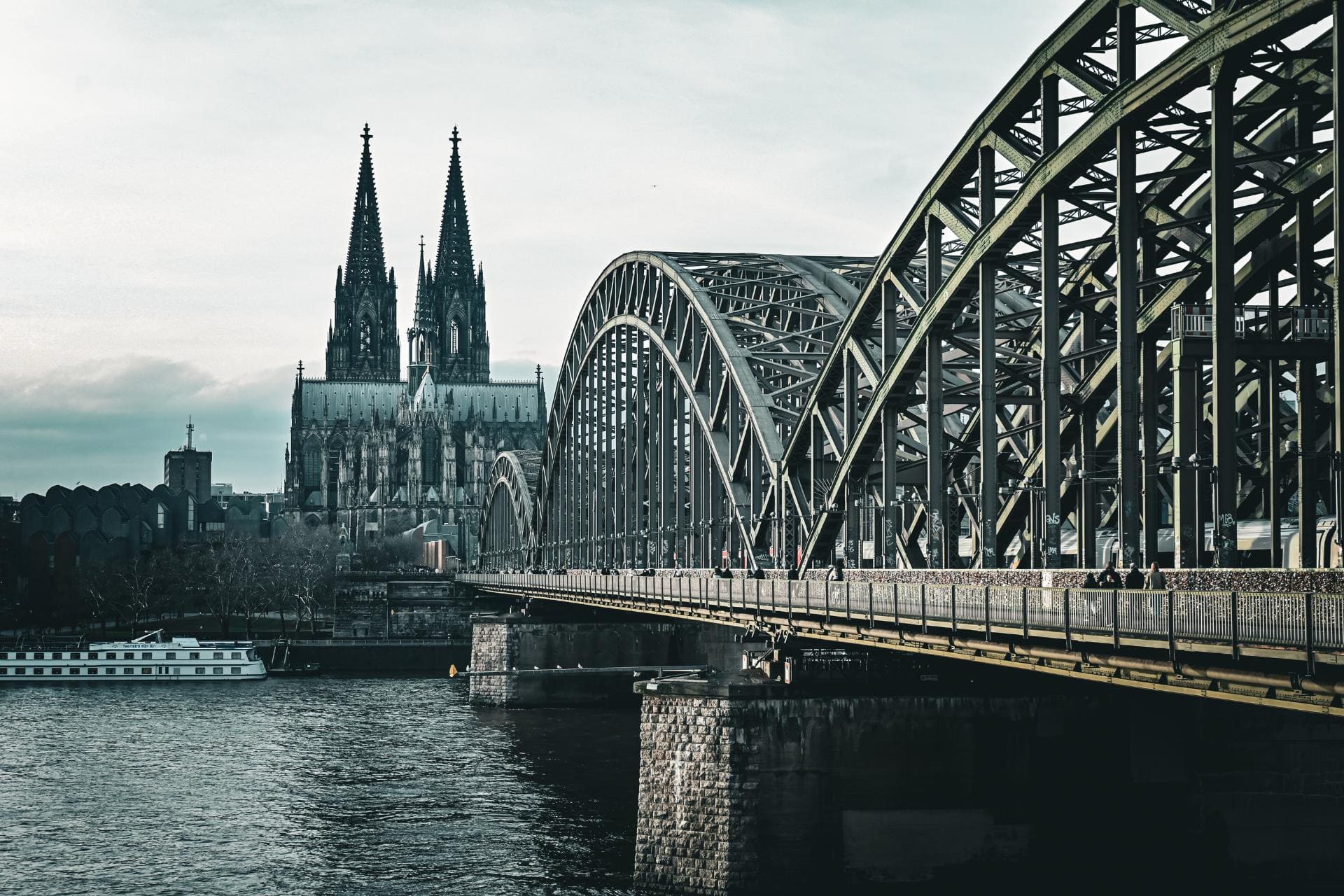
This week I'm on a UNESCO World Heritage and Christmas market tour. Yesterday I visited Aachen Cathedral, today I'm going by train read more
About me: I love to travel, write and photograph - preferably in places where the past is visible. Whether it's half-timbered towns, castles or quiet landscapes - there's something in every place that touches you and inspires you to think further. With my blog Angie's Travel Routes I would like to inspire you to discover Germany on your own. I share my experiences, personal impressions and practical route tips to make your next trip a special experience.
You can find out more about me to my newsletter.

 Deutsch
  English