
Between Cliffs, Half-Timbered Towns and World Heritage Sites
The Swabian Alb is still one of Germany's underrated regions. is still one of Germany’s most underrated regions. Yet it offers an extraordinary variety: rugged cliffs with sweeping views, mysterious caves, charming towns, ancient castle ruins, and peaceful monasteries. Those who visit discover not only a landscape full of contrasts, but also traces of over 40,000 years of human history. In this guide, I’ll show you the most beautiful highlights, day trip ideas, and hidden gems across the Swabian Alb.
👉 Tip: If you’d like to explore the Swabian Alb more deeply, you’ll find two detailed road trip routes through the region in my article about Germany's best road trips – perfect for discovering this unique area over several days (or even weeks).
What Makes the Swabian Alb so Special?
Traveling across the Swabian Alb (Swabian Jura) means discovering a landscape full of contrasts: rugged white limestone cliffs rise above forested valleys, while gentle plateaus open up to sweeping views of the Alps. Between castles, monasteries, and half-timbered towns, the Alb tells its story in many layers – from Ice Age art to industrial heritage. Along its hiking trails, you’ll find scenic viewpoints, dramatic rock formations, and dense beech forests glowing in warm autumn colors. But each season has its own charm – the Alb is a region that’s diverse, authentic, and often surprisingly peaceful. And the best part: many of its most beautiful spots are still true hidden gems, far away from the crowds.
An Overview of the Swabian Alb Highlights
Download this interactive map to your phone, and you’ll always know where the next highlight is waiting for you. In my step-by-step guide How to Plan a Route with Google Maps , I’ll show you exactly how to do it and how to use your map offline while traveling through Germany.
Castles, Palaces and Ruins
Majestically perched on the limestone cliffs of the Swabian Alb, countless castles, palaces and ruins are among the region’s most striking landmarks. Many of them tell stories of knights, dukes and kings – and offer sweeping views across the foothills of the Alb. Whether it’s the fairy-tale atmosphere of Lichtenstein Castle, inspired by literature, or the ivy-covered mystery of Hohenurach Castle Ruin, history lovers and romantics alike will be captivated. Equally rewarding are the hiking trails surrounding these fortresses, where nature and culture blend seamlessly into one unforgettable experience.
1. Hohenzollern Castle
The crown of the Swabian Alb
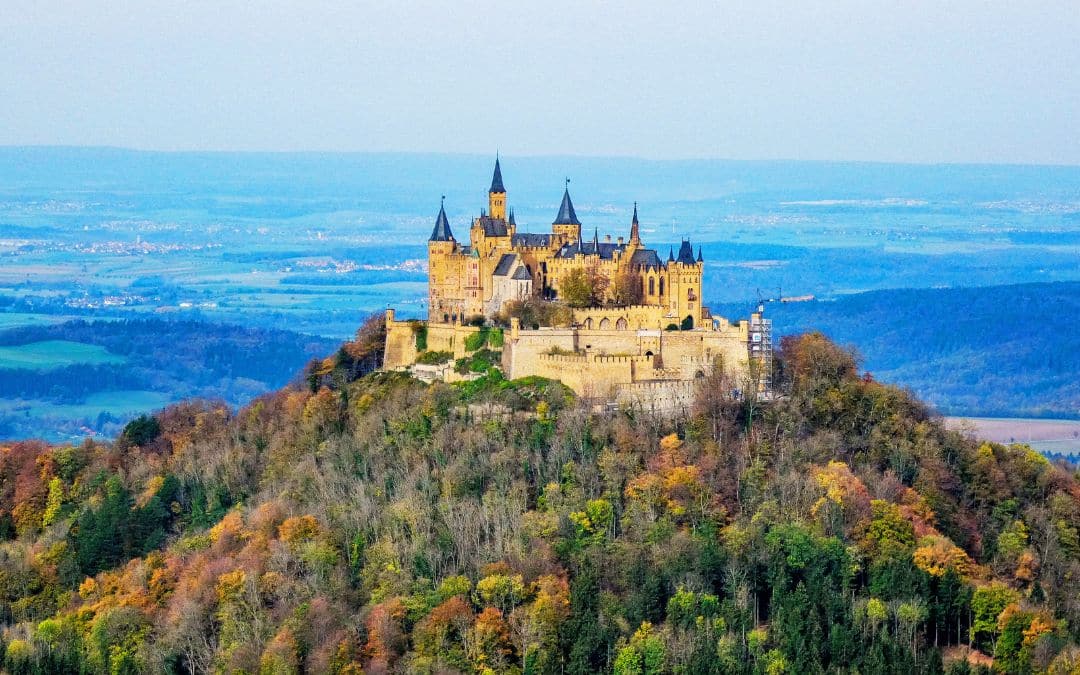
Hohenzollern Castle near Hechingen is undoubtedly one of the most famous and most visited sights in the Swabian Alb - a real postcard motif. It is the ancestral seat of the House of Hohenzollern, the dynasty that produced the Kings of Prussia from 1701 and the German Emperors from 1871 to 1918. The castle sits dramatically atop a cone-shaped hill at an elevation of 850 m (2,790 ft).
Although the current structure was built only in the 19th century in neo-Gothic style, the site’s history dates back to the 11th century. Over the centuries, the fortress was destroyed, abandoned, and rebuilt several times. It was King Frederick William IV of Prussia who reconstructed the castle as a romantic monument to his family’s legacy. Today, visitors can explore the magnificent interiors, including the Treasury with the Prussian royal crown, and enjoy breathtaking views from the bastions – on clear days reaching as far as 100 kilometres across the foothills of the Alb.
Tip for your visit:
Visit on a clear day for the best panoramic views over the Swabian Alb, the Black Forest, and sometimes even the Alps. One of the most stunning vantage points is the Zeller Horn, especially in fall when the morning mist lifts and the golden forests frame the castle perfectly.
✨ Royal winter magic:
During Advent, Hohenzollern Castle turns into a true winter fairytale. The event called "Royal winter magic" transforms the courtyard into a festive scene filled with twinkling lights, the scent of mulled wine, local crafts, and a charming fairytale forest – a feast for all the senses.
Find out more in my article History, splendor and mulled wine at Hohenzollern Castle.
🥾 Hiking tip: The premium hiking trail "Traufgang Zollernburg-Panorama" most scenic routes. The circular trail (8.7 km / 5.4 mi) offers ever-changing landscapes and spectacular viewpoints such as the Zeller Horn, one of the best photo spots in the Alb with a magnificent view of the castle, as well as the Hangender Stein and the Raichberg Tower. It’s a moderate but rewarding hike – especially in the golden fall, when the Swabian Alb glows in all its colors.
Hohenzollern Castle Visitor Information
Address: Burg Hohenzollern, 72379 Burg Hohenzollern / Hechingen
Opening hours: daily 10 a.m. - 5 p.m. (last admission)
Admission: online €26 (regular), €16 (reduced); ticket office €29 / €19. Parking and shuttle bus to the castle are already included in the ticket price.
Visit the official website of Hohenzollern Castle.
2. Lichtenstein Castle
The Fairytale Castle of the Swabian Alb
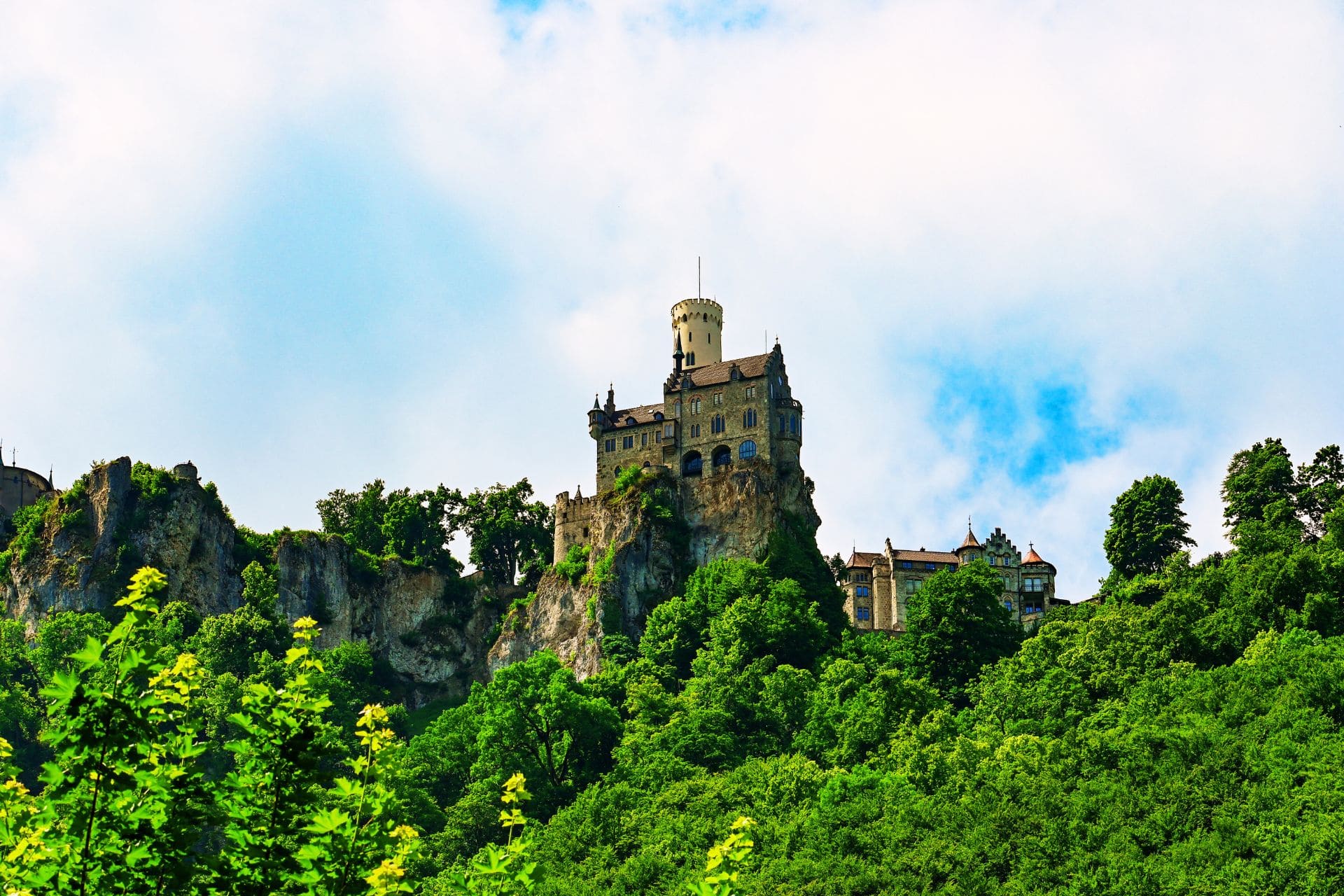
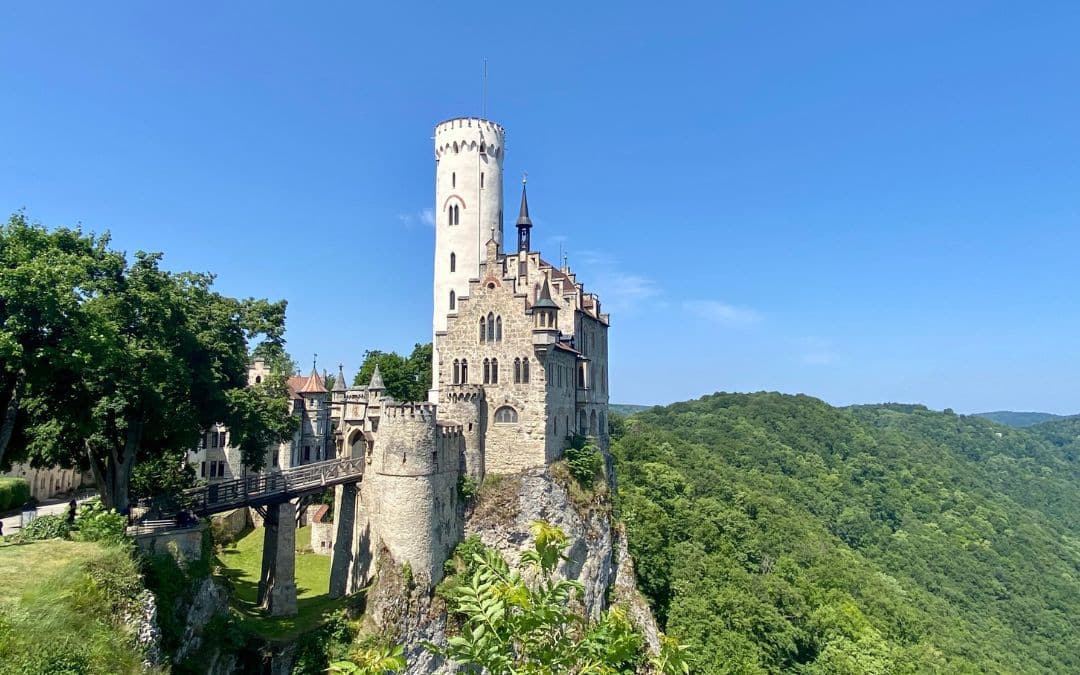
Perched picturesquely on a rocky spur along the edge of the Swabian Alb, Lichtenstein Castle is a romantic jewel built in the historicist style. Inspired by the novel “Lichtenstein” by the poet Wilhelm Hauff, Duke Wilhelm of Urach had the castle constructed in the mid-19th century. Its striking architecture – with a turreted tower, drawbridge, and battlements – makes it one of the most photogenic castles in Southern Germany.
Inside, visitors can admire historical rooms, elaborately decorated furniture, and a beautifully restored chapel. Guided tours (required for interior visits) offer fascinating insights into aristocratic life in past centuries – and into the story behind this remarkable building.
For the best view of the castle, head to the viewpoint within the castle grounds, where the setting truly lives up to its fairytale reputation.
🥾 Hiking tip: A particularly scenic hike starts directly at Lichtenstein Castle and leads to the Nebelhöhle (Fog Cave) before looping back. The premium trail "hochgehträumt" leads through light forests and to several panoramic viewpoints. One highlight is the Gießstein, from where you can enjoy breathtaking views of the rugged cliffs surrounding Lichtenstein Castle. Another excellent vantage point offering a wonderful perspective of the castle perched above the Echaz Valley is near the old Lichtenstein castle ruins.
👉For more tips and photos, see my article A Perfect Day Around Lichtenstein Castle.
Lichtenstein Castle Visitor Information
Address: Schloss Lichtenstein 1, 72805 Lichtenstein
Opening hours: daily 9:00 a.m. – 5:30 p.m.
weekends & public holidays only, 10:00 a.m. – 4:00 p.m.
(Last admission 30 minutes before closing time)
Admission: Castle courtyard €5 (reduced €4, children 6–12 years €3) Guided interior tour €14 (reduced €12, children €8) For the most recent ticket information, visit to my newsletter.
For further information, visit the official website of Lichtenstein Castle.
3. Hohenneuffen
The Largest Fortress Ruins on the Swabian Alb – with Views and Wine
The ruins of one of Southern Germany’s largest hilltop fortresses rise high above the town of Neuffen , on the edge of the Swabian Alb. Visible from afar, Hohenneuffen offers not only spectacular panoramic views over the Alb and its foothills, but also fascinating insights into the history of fortress architecture in southwestern Germany.
The castle’s origins date back to the 12th century. In the 16th century, it was expanded into a state fortress, later served as a state prison, and today it’s a popular excursion destination – whether for hiking, dining at the panoramic beer garden, or attending events such as the multicultural Festival of Nations or the Burgsommer Hohenneuffen (Hohenneuffen Castle Summer) with concerts and cabaret performances.
On clear days, paragliders circle gracefully above the fortress, creating a stunning sight together with the castle and surrounding landscape, especially at sunset. From the Wilhelmsfels viewpoint (a short walk from the parking area), you’ll get one of the best views of the fortress and its scenic surroundings.
🥾 Hiking tip: The hochgehfestigt circular trail (9.5 km / 5.9 mi) starts in Beuren and is one of the region’s premium hiking routes. It combines wide open views, sun-drenched vineyards, and shady forest paths. A more direct route leads from Neuffen up to the fortress – shorter, but steep and full of rewarding vistas.
💡 Historical highlight: In 1948, the Hohenneuffen fortress hosted the Three-State Meeting , marking the beginning of political discussions that eventually led to the formation of the federal state of Baden-Württemberg in 1952.
Hohenneuffen Fortress Visitor Information
Address: Burg Hohenneuffen, 72639 Neuffen
(Parking available at the end of Hohenneuffenstraße; about a 20–30 minute walk to the fortress.)
Opening hours: Open to visitors at any time
(Beer garden and event spaces open seasonally – please check the website for details.)
Admission: Access to the fortress is free of charge
For further information, visit the official website of Hohenneuffen Fortress.
4. Teck Castle
Observation tower with hiking lodge - and historical name
Strictly speaking, Teck Castle is no longer a castle - at least not in the medieval sense. The original fortress was destroyed during the Peasants' War in 1525. All that remains is the name. Today, the Teckberg near Kirchheim unter Teck is home to a lookout tower with an adjoining hiking lodge and a popular restaurant - a perfect destination for hikers, nature lovers and anyone who enjoys distant views. Below the observation tower, "cave explorers" can explore the Sybil hole reach.
💡 Worth knowing
The viewing tower that can be seen today was built by the Kirchheim Beautification Association back in 1889 - at a time when the region was rediscovering its castle ruins as a romantic destination for excursions. The name "Teck" goes back to the noble family of the Dukes of Teck, a branch of the Zähringer family that played an important role in the Middle Ages.
🥾 Hiking tip
Teck Castle can be reached in around 30 minutes from the Hörnle parking lot - steep in places, but easy to walk up. The climb is worth it: from the tower you can enjoy a magnificent view over the foothills of the Alb. There is also a dense network of hiking trails around the Teckberg, including the premium hiking trail "hyped up" and a section of the Albsteig (long-distance hiking trail HW1, difficult!).
👉 Extra Tip: If you visit Teck Castle, it is also worth making a detour to the old town of Kirchheim unter Teck. The charming little town boasts well-preserved half-timbered houses, a pretty market square and a Renaissance fortress that served as a residence for the widows of the Dukes of Württemberg for centuries. Find out more in my Article about Kirchheim.
Teck Castle info
Address: Teck Castle, 73230 Kirchheim unter Teck (it is best to drive to the "Hörnle" parking lot)
Opening hours: The observation tower is freely accessible during the day (put €1 in the cash box).Usually open from March to November (check the website for exact times)
Admission: Site free, observation tower 1€; overnight stay & catering in the hiking home for a fee
Visit the Teck website.
5. Reußenstein Castle Ruins
Castle romance above the Neidlingen Valley
Spectacularly situated on a rock above the Neidlinger Valley, the ruins of Reußenstein Castle are among the most impressive ruins in the Swabian Alb. Built in the 13th century, the castle was once used to secure the Alb ascent and is perched on a steep cliff - a place where history and nature come together in a fascinating combination.
The well-preserved ruins are freely accessible and reward visitors with sweeping views over the Neidlingen valley and the striking mountain ranges of the Swabian Alb. A special feature are the weathered but still clearly recognizable architectural details such as window openings, the former palas and the former chapel.
🥾 Hiking tip: A popular tour leads from the hiking parking lot Reußenstein over to the ruins and on to the Heimenstein Cave to the Randecker Maar and Schopflocher Moorthen via the Bahnhöfle hiking parking lot back to the Reußenstein parking lot. If you have less time, you can reach the castle from the Reußenstein parking lot after a 10-minute walk.
💡 Tip: The Reußenstein is a popular place for sunsets and romantic picnics - sturdy shoes are advisable!
Reußenstein castle ruins info
Address: Reußenstein parking lot, Reußensteinstraße, 73252 Neidlingen
Opening hours: Free access all year round
Admission: free
For further information, visit the Website of the Reußenstein castle ruins.
6. Hohenurach Castle Ruins
Far-reaching views and wild romance over the Erms Valley
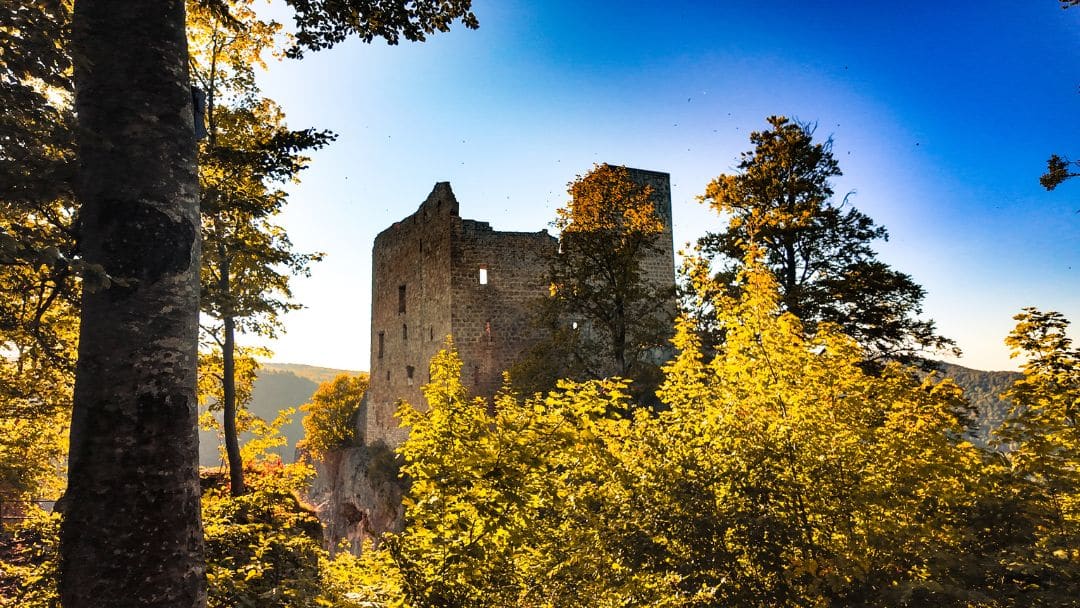
The ruins of Hohenurach Castle are enthroned on a rocky spur above the spa town of Bad Urach - a destination for anyone who loves history and views in equal measure. The castle was founded in the 11th century by the Counts of Urach and later developed into a Württemberg fortress. It was razed in the 18th century, leaving only the impressive ruins with sweeping views over the Erms Valley and the Swabian Alb.
In addition to its strategic importance, the castle was once notorious as a state prison. Today, the remains are freely accessible - a perfect stage for hikers who are looking for adventure and want to be rewarded with a panoramic view.
🥾 Hiking tip: The ascent from the Urach waterfall to the Hohenurach castle ruins is short but steep - ideal for a circular hike that also includes the waterfall and the plateau. Sturdy footwear is a must. Particularly beautiful: a visit in the late afternoon, when it is quiet and the light falls softly over the Alb slopes.
💡 Tip: The ruins are located above Bad Urach - one of the most beautiful half-timbered towns in the Swabian Alb. Combine a trip to the waterfalls and castle ruins with a stroll through the town.
Hohenurach castle ruins info
Address: 72574 Bad Urach (no postal address; starting point e.g. parking lot P23 at the Urach waterfall, Maisentalstraße)
Opening hours: freely accessible all year round. Please note: The castle ruins are currently being renovated and must therefore occasionally be completely closed to visitors (as of 2025). Check the website for the latest information.
Admission: free
Visit the Website of the Hohenurach castle ruins.

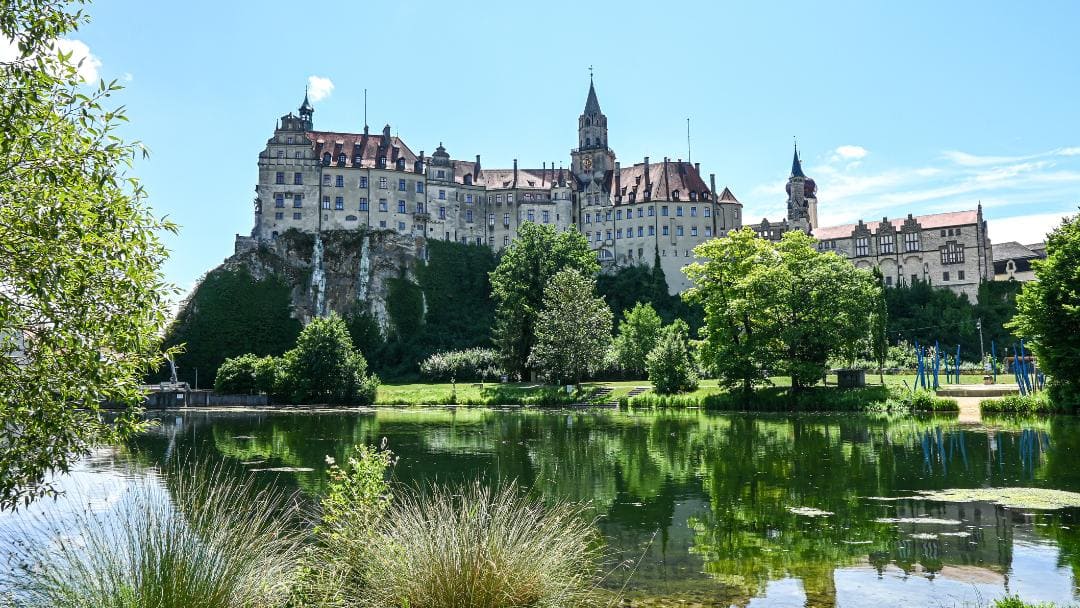
7. Hohenzollern Castle Sigmaringen
The princely residence of the Hohenzollerns in the middle of the city
In the heart of Sigmaringen, the imposing Hohenzollern Castle sits enthroned on a rock above the Danube. Unlike the famous Hohenzollern Castle, this palace was never a romanticized replica, but a real princely residence for centuries. It still belongs to the Hohenzollern family today and is one of the largest city palaces in southern Germany.
Today's appearance is the result of several construction phases - from the medieval castle to the baroque and finally neo-Gothic residence. Particularly impressive is the completely preserved interior with its magnificent salons, armory, palace kitchen and the magnificent princely hall. On a guided tour, you can immerse yourself in the world of the nobility - from everyday court life to historical turning points such as the end of the monarchy in 1918. The castle's armory houses the largest private collection of weapons in Europe.
🥾 Hiking tip:
A hike through the Princely Park Inzigkofen (only 3 km from Sigmaringen) is particularly worthwhile: over the Devil's Bridge and the suspension bridge to the famous Amalienfelsen.
💡 Worth knowing:
In 1944, Sigmaringen briefly became the Replacement residence of the Vichy government and thus the French capital, so to speak, after the Allies had liberated large parts of France.
📸 Want more impressions?
In my article 12 of 12 in July: Sigmaringen Castle and Inzigkofen Princely Park I'll take you on a trip to Sigmaringen Castle and the Princely Park in Inzigkofen - with lots of personal tips and photos:
Hohenzollern Palace Sigmaringen Info
Address: Sigmaringen Castle, 72488 Sigmaringen
Opening hours: Open daily (including Mondays) April to October: 9:30 a.m. - 5:30 p.m., November to December 23
Thursday - Sunday from 10 a.m. to 5 p.m., December 26 to January 6 daily from 10 a.m. to 5 p.m.
(last admission: 1 hour before closing time) [as of 2025]. You can find the current opening hours to my newsletter.
Admission: regular 15 €, reduced 13 €, children (6-17 years) 7 €, family ticket 40 €
→ Guided tour or audio guide included in the price
You can find all the latest information on the Website of the Hohenzollern Castle Sigmaringen.
Natural wonders of the Swabian Alb
From bright blue spring pools to moss-green waterfalls - the Swabian Alb inspires with extraordinary natural phenomena that are hard to find anywhere else in Germany. Its varied landscape is characterized by former volcanoes, mysterious karst springs, pristine moors and gently carved river valleys.
Those who travel here will not only discover spectacular views and photogenic landscapes, but also experience first-hand how geology, water and time combine to create true natural wonders. Hikes through these unique habitats are particularly rewarding - sometimes wild and romantic, sometimes quiet and mysterious.
8. Urach waterfall
The most spectacular waterfall in the Swabian Alb
It is one of the region's most famous natural highlights - and is a worthwhile excursion destination at any time of year: the Urach waterfall plunges over 37 meters into the depths and is fed by a karst spring on the slopes of the Swabian Alb. The spectacle is particularly impressive after rainfall or during snowmelt, when the water cascades over the moss-covered limestone tufa terraces.
From the Maisental hiking parking lot, you can easily reach the waterfall on a well-maintained footpath along the Brühlbach stream. If you're feeling more athletic, take the steep path up to Hochwiese - at the top, you'll not only have a view of the thundering abyss, but also a wooden bridge over the bubbling water and sweeping views over the Erms Valley.
🥾 Hiking tip: One of the most beautiful circular tours is the approximately 7 km long "Wasserfallsteig" route, one of the certified Grafensteige. It connects the Urach waterfall with the Hohenurach castle ruins, several viewpoints and offers fantastic panoramic views of the Alb along the way.
💡 Worth knowing: The waterfall was created by calcareous tufa deposits that formed over centuries from the lime-rich spring water - an impressive example of geological processes in the karst landscape of the Swabian Alb.
💡 Tip: Plan some time for a stroll through Bad Urach the pretty little half-timbered town at the foot of the Albtrauf with its old town, castle and spa gardens is well worth a stopover.
Urach waterfall info
Address: Hikers' parking lot Uracher Wasserfälle P23, Vorderes Maisental 6, 72574 Bad Urach
Opening hours: freely accessible all year round
Admission: free
Click here to go to the official website of the City of Bad Urach.
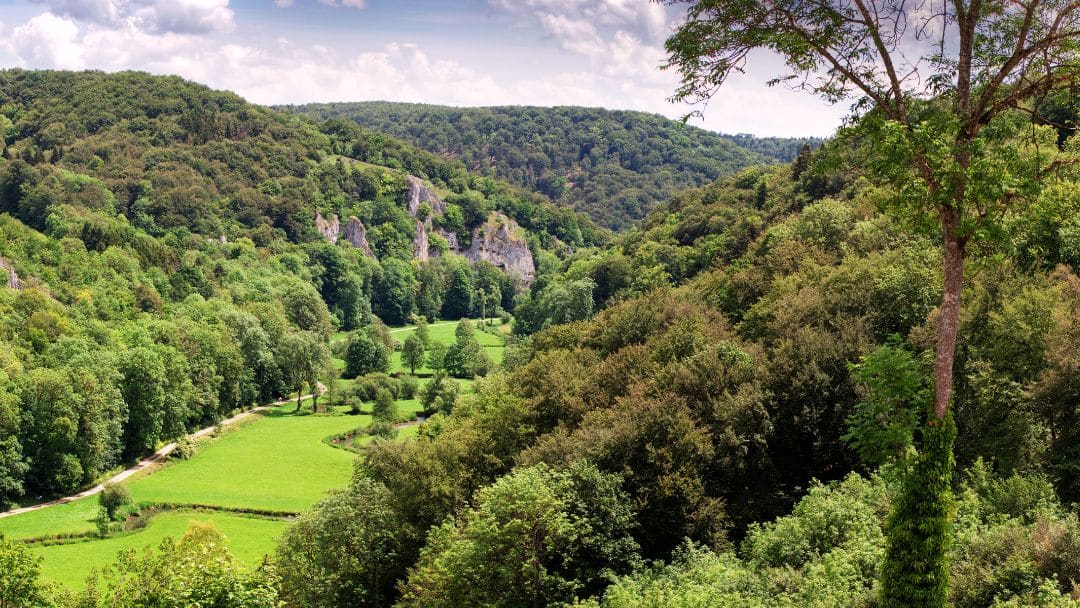
9. Great Lauter Valley
Natural beauty with rocks, river and castle ruins
The Great Lautertal, through which the Große Lauter meanders picturesquely, is one of the most spectacular natural landscapes in the Swabian Alb. It combines Juniper heaths, bizarre limestone formations, hidden ruins and idyllic villages - in the heart of the UNESCO Global Geopark and Swabian Alb Biosphere Reserve. Awarded the title of "Natural Wonder of Germany 2019", the Lauter Valley offers a pure atmosphere for anyone who wants to experience tranquil beauty, cultural heritage and nature.
🥾Hiking tip: On a hike on one of the premium hiking trails "high pitched", "hochgehswiggert" or "high-backed" you can experience the Great Lauter Valley in all its beauty. These routes take you over mountain ranges with far-reaching views of the Lauter Valley, past old castle ruins and fragrant rough pastures - through a landscape that is reminiscent of wilderness and history in equal measure. Susanne Glas from the Travel blog Travelsanne gives in her contribution about a Hiking weekend in the Great Lauter Valley lots of tips on all three routes.
💡 Tip: Horse lovers will enjoy a visit to the Main and State Stud Marbach - the oldest stud farm in Germany - get their money's worth.
👉 Tip: for history buffs: In the Lautertal village Buttenhausen was home to one of the few Jewish village communities that existed in the Alb until 1941. In the Jewish Museum and on a Historical tour commemorates the life and work of Jewish fellow citizens, many of whom did not survive the Nazi terror.
Great Lauter Valley Info
Location: Großes Lautertal (between Gomadingen-Offenhausen and Münsingen, along the Große Lauter)
Access to the ruins: Some of the castle ruins are freely accessible (e.g. Derneck Castle, the ruins of Bichishausen and Hohengundelfingen Castle) and offer impressive views of the landscape, while others are closed due to dilapidation or are privately owned. The highest density of castles can be found in the section between Buttenhausen and Indelhausen.
Website: More info at Swabian Alb!
10. Volcanic mountain Jusi
Promising witness to the fiery past
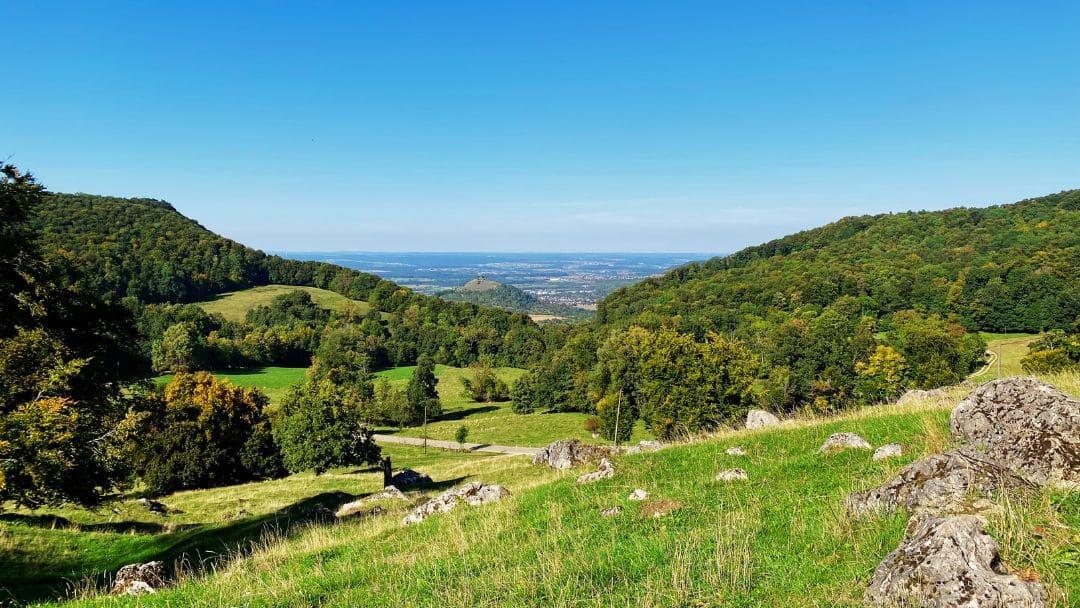
The Jusi near Kohlberg is the most impressive volcanic vent of the so-called Swabian volcano - a geological feature in the foothills of the Alb, which was formed around 17 million years ago by violent eruptions. The cone-shaped mountain rises clearly visible from the landscape and offers one of the most beautiful views of the Alb foothills and the Swabian Alb from its high plateau.
The southern slope is a protected FFH and nature reserve, and in spring the purple blossoms of the pasqueflower shine on the juniper heaths. The plateau around the summit cross is one of the most impressive vantage points in the Swabian Alb - but can only be reached via steep, sometimes rocky paths.
🥾 Hiking tip: Paradise trail about the Jusi: A beautiful circular trail leads from the hiking parking lot Caterpillar valley near Kohlberg over the steep north-western slope to the foothills of the Jusi and on to the Summit cross. Then it's downhill through sparse beech forests to Sattelbogen. At the orchards on the Sommerberg you can enjoy another magnificent view.
💡 Worth knowing: At 500 m, Kappishäusern am Jusi is Germany's highest wine village. The volcanic rock warms up quickly - ideal conditions for the vines.
👉 Extra Tip: The Thermal baths Beuren and Bad Urach use the heat from a depth of 770 meters for your health baths.
Jusiberg Info
Address Hikers' parking lot Raupental (Jusiberg): Metzinger Str. 90, 72664 Kohlberg
Opening hours: freely accessible all year round
Further information and hiking trails around the Jusiberg on the Website of the municipality of Kohlberg.

11. Blautopf
The legendary spring pot - turquoise blue and mysterious
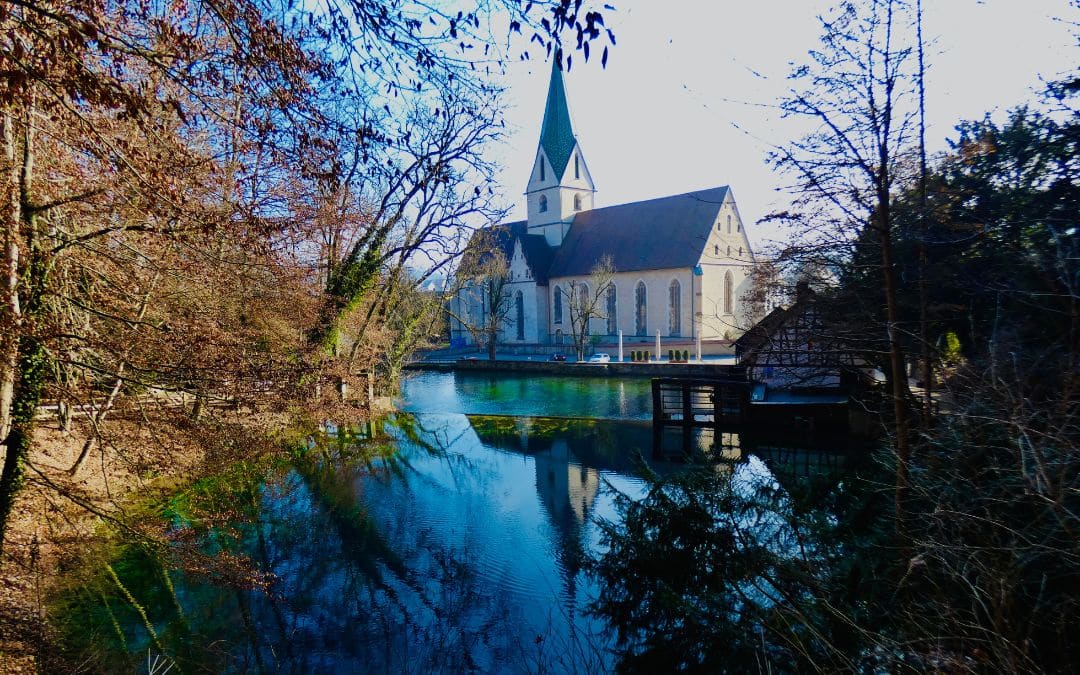
Deep blue, crystal clear and of mysterious beauty - the Blautopf is not only one of the most famous karst springs in Germany, but also a place full of myths. In the famous legend The beautiful Lau In one of Eduard Mörike's famous stories, a mermaid lived there in an underground palace, who, with the help of the women of Blaubeuren, found her laughter and finally her happiness in love.
From fairy tales to facts: From the depths of the Swabian Alb, the water of the largest underground river system in southern Germany flows to the surface in the Blautopf. The intense color of the water is created by the finest lime particles that scatter the light - particularly brilliant on sunny days.
The Blautopf lies on the edge of the pretty old town of Blaubeuren and is not only a popular photo motif, but also a starting point for explorations: Directly at the Blautopf is the Historic hammer mill (closed until the end of 2028 due to renovation work)and right next door rises the impressive Blaubeuren Monastery with its famous high altar - a late Gothic masterpiece that you should not miss.
💡 Worth knowing: The Blautopf is the visible part of one of the largest underground cave systems in Germany and the source of the River Blau. The Blautopf cave has only been opened up in recent decades through elaborate dives - the dangerous exploration of the underwater caves still fascinates speleologists to this day.
🥾 Hiking tip: A beautiful circular hike leads from the Blautopf through the picturesque Blautal valley, past rocks, forests and over the so-called Rock climb back to Blaubeuren (approx. 6 km, moderately difficult, sure-footedness required). If you prefer a more leisurely walk, you can also take the shorter Blautopfrundweg (around 3 km).
Blautopf info
Address: Blautopfstrasse, 89143 Blaubeuren
Opening hours: free
Museum in the historic hammer mill: because of Renovation work around the Blautopf until the end of 2028 closed. Information on the current status of the construction work at the Blautopf can be found on the Blaubeuren website. The Blautopf can be visited and viewed via two temporary bridges despite the reconstruction work.
Current information: blaubeuren.de
12. Schopflocher Moor
Unique raised bog on the Alb plateau
A moor in the Swabian Alb? Sounds unusual at first - but the Schopflocher Moor is actually a real natural wonder. The only permanently water-bearing raised bog in the region is located on the water-poor karst plateau of the Central Alb. It was created by the weathering of basalt tuff in a volcanic chimney, which led to the formation of an impermeable clay layer - a geological peculiarity in the otherwise permeable karst landscape.
Today the Schopfloch moor a valuable nature reservewhich is home to rare plants such as cotton grass, marsh marigold and sundew. If you're lucky, you might even encounter the now rare red-backed shrike on a hike or see dragonflies dancing above the moor.
🥾 Hiking tip:
The Moor Experience Trail offers an easy circular trail with numerous information boards on the flora, fauna and geology of the area. The best starting point is the Peat pit parking lot, from where it is only a short walk to the wooden walkway. The short tour is also suitable for families and takes around 45-60 minutes.
💡 Tip: Combine your visit with a detour to the nearby Randecker Maar - an impressive relic of volcanic activity. The area is only around 2 km away and offers a fantastic view of the Alb foreland. The circular hike From the moor to the maar takes you to many highlights of this beautiful region.
Schopflocher Moor info
Address: Schopflocher Alb Nature Conservation Center, Beim Randecker Maar 1, 73252 Lenningen-Schopfloch
Opening hours: The moor is accessible all year round. The Torfgrube parking lot is very close to the Schopflocher Moor adventure trail with its wooden footbridge and just a few meters from the Gasthof Albengel with its beautiful beer garden.
The nature conservation center is located in the Summer half year open Tuesdays to Saturdays from 10:00 - 17:00, on Sundays and public holidays from 11:00 - 17:00, in the Winter half year Tuesdays to Saturdays only from 1 p.m., closed on Saturdays (please check opening hours online before your visit).
Admission: Access to the moor is free of charge.
Admission to the nature conservation center: free, donations welcome.
For further information, visit the Website of the Schopflocher Alb Nature Conservation Center.

13. Randecker Maar
Volcanic window into the history of the earth
Anyone who thinks that the Swabian Alb is all limestone cliffs, caves and castle ruins will be disappointed at the Randecker Maar You will be surprised: here you are looking into the crater of a volcano that was active around 17 million years ago - today a fascinating place for nature lovers and amateur geologists. The former volcanic vent has long been extinct, but the funnel-shaped depression is still a clear reminder of its explosive past.
Today the area is a Hotspot of biodiversity. The Randecker Maar is particularly famous for its bird flight observations in the fall. Thousands of birds pass this spot on the Albtrauf every year as they fly south - a spectacular natural phenomenon that has been scientifically documented here for decades.
🥾 Hiking tip: An informative Geo trail with viewing benches and information boards leads along the edge of the crater. From there, you can also hike further into the Zipfelbach gorge.
💡 Tip: Combine a visit to the Randecker Maar with the many other sights and natural beauties of the surrounding area (Schopflocher Moor, Reußenstein ruins, Zipfelbach Gorge, Breitenstein viewpoint, Teck Castle ...). There are many beautiful hiking trails to choose from. You can find some tips here.
Randecker Maar info
Address: Randecker Maar hiking parking lot on the K1250 (access to the maar directly on the opposite side of the road)
Opening hours: The area is freely accessible all year round. Detailed information on the Randecker Maar can be found at the Schopflocher Alb Nature Conservation Center.
Admission: The area is freely accessible all year round.
14. Lake Federsee
Moorland lake, bird paradise and UNESCO World Heritage Site
The Federsee near Bad Buchau is the largest lake in Upper Swabia at 1.4 km² and is also a unique natural paradise. Originating from an ice-age glacial lake, it silted up over thousands of years to become a moorland area that is now home to over 270 bird species and rare plants.
One highlight is the Spring lake jettya 1.5-kilometre-long wooden walkway that leads directly from the parking lot at the Federsee Museum into the moor. On the path, from a viewing tower and on the observation platforms, you can experience nature up close and enjoy sweeping views over the lake and reeds. A visit in spring or fall is particularly impressive when thousands of migratory birds stop off here.
💡 Special tip: There were prehistoric settlements around the Federsee. Pile dwellingswhich has been part of the UNESCO World Heritage Site "Prehistoric Pile Dwellings around the Alps" are. A vivid impression of these settlements is provided by the nearby Federsee Museum Bad Buchauwhich provides an insight into life in the Stone and Bronze Ages with original finds and reconstructed houses.
Federsee info
Address: Large parking lot at the Federsee Museum, Federseeweg, 88422 Bad Buchau
Opening hours: The Federseesteg is open 24 hours a day all year round.
Admission: 2,50€
For further information, visit the Website of the NABU Nature Conservation Center Federsee.

You like this post and want to get the latest updates? Then subscribe to my newsletter!
Churches and Monasteries of the Swabian Alb
Spiritual places with ornate architecture and eventful history
Between cliffs and river valleys, the Swabian Alb is home to magnificent churches and impressive monasteries, many of which have been centers of faith and education for centuries. Whether Gothic cathedral, Baroque prelate monastery or quiet Cistercian retreat — they invite you to devotion, to marvel or simply to enjoy the silence. Many of these spiritual places impress with their ornate details, unique location and eventful history.
15. Ulm Minster
The highest church tower in the world
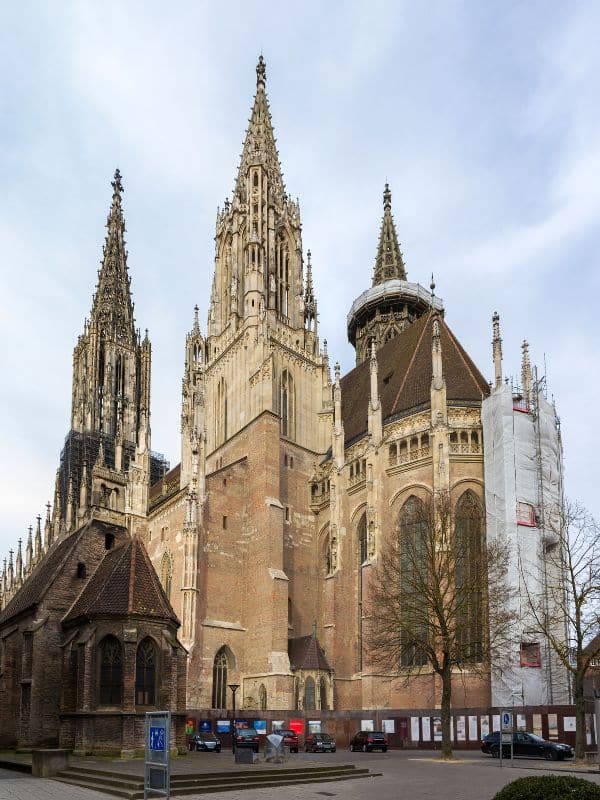
Ulm Minster is a masterpiece of Gothic architecture - and has the highest church tower in the world at 161.53 meters. If you climb the 768 steps to the top platform, you will be rewarded with a breathtaking view over Ulm, the Danube valley and, in good weather, as far as the Alps. Construction of the imposing church began in 1377, but the tower was only completed in the 19th century - entirely according to the medieval plans.
In addition to the tower, the richly decorated main portal, the colorful windows from the 15th century and the famous pulpit by Ulm sculptor Jörg Syrlin are also impressive.
If you are sure-footed and have a head for heights, you can climb the 768 steps to the top of the tower The climb is a unique experience with spectacular views over Ulm, the Danube valley and, on a clear day, as far as the Alps. Note: Due to construction work, the church tower can currently only be climbed up to platform 2).
💡 Worth knowing: The church became Protestant during the Reformation (1530) and is still the largest Protestant church in Germany today. Inside, it impresses with its filigree tracery windows, the magnificent choir stalls by Jörg Syrlin the Younger from the 15th century and the sheer expanse of the nave.
📍 Tip: Combine your visit to the cathedral with a Tour through the old town of Ulmwhich are linked to the Fishermen's quarter, the Crooked house and the City wall directly on the Danube is one of the most beautiful in southern Germany.
Ulm Minster info
Address: Münsterplatz 21, 89073 Ulm
Opening hours: April to 14. October: daily 9 am to 6 pm, October 15 to March: daily 10 am to 5 pm (until 5 pm during the Advent season). Please note: No visits during church services and concerts. Current information on the website.
Admission: Minster free; regular tower tour €9, reduced €6. Ulm Minster is currently being renovated. The view from the 1st platform is therefore severely restricted, the 143m level is closed. The 102m level (platform 2) can be climbed daily from 10 am to 5 pm (as of September 2025).
For further information, visit the Webiste of the Ulm Minster.
16. Wiblingen Monastery
Baroque synthesis of the arts at the gates of Ulm
Just a few kilometers south of Ulm lies the Wiblingen Abbey, a jewel of late Baroque architecture. The former Benedictine abbey was founded in 1093 and completely rebuilt in the 18th century. Today it is one of the most important monasteries in Upper Swabia.
Even from the outside, the symmetrical monastery complex with its wings, towers and gatehouses is impressive. The rococo library with its marble columns, gilded figures and ceiling frescoes is particularly worth seeing - a prime example of Baroque splendor.
The monastery church of St. Martin is also a masterpiece: the bright, light room effect, lavish stucco work and finely crafted altars make it one of the most beautiful sacred spaces in the region.
💡 Tip: Wiblingen Monastery can be easily reached with a Excursion to Blaubeuren and the Blautopf connect.
Wiblingen Monastery Info
Address: Schlossstraße 38, 89079 Ulm-Wiblingen
Opening hours: Varies depending on the season, public holidays and events. Please check the opening hours on the website check.
Admission: Basilica free, library hall regular 6,00€, reduced 3€, family ticket 15€ (guided tours cost extra)
For further information, visit the Webiste of the Wiblingen monastery.

CC-BY-SA 4.0
17. Blaubeuren Monastery
Gothic monastery complex with baroque splendor and direct proximity to the Blautopf
On the edge of the picturesque old town of Blaubeuren and right next to the famous Blue pot lies the former Benedictine monastery, which is one of the most important late Gothic monastery complexes in southern Germany. Founded back in 1085, the complex was fundamentally redesigned in the 15th century and took on its current form. The magnificently carved high altar from 1493 and the choir stalls, two masterpieces of the Ulm School, are particularly impressive. The late Gothic ribbed vault and the idyllic cloister also make a tour of the monastery an art-historical experience.
💡 Tip: Combine your visit with a stroll to the Blue potwhich, with its deep blue water and karst cave legend, is one of the most famous natural wonders of the Swabian Alb. The prehistoric museum in Blaubeuren exhibits finds from the UNESCO World Heritage caves in the Swabian Alb exhibited, including the over 30,000 year old Venus vom Hohle Felsone of the world's first depictions of the human body.
💡 Additional tip: If you are traveling from Ulm to Blaubeuren, it is worth stopping at the Wiblingen Monastery with its baroque monastery library - one of the most impressive buildings of its kind in southern Germany.
Blaubeuren Monastery Info
Address: Klosterhof 5, 89143 Blaubeuren
Opening hours: March-October: daily 10 am - 5 pm; November-February: Monday to Friday 2 pm - 4 pm, Saturday, Sunday and public holidays 11 am - 4 pm.
Admission: egular € 5, reduced € 2.50, combined ticket with Badhaus € 7, children up to 18 years free.
For further information, visit the Website of the Blaubeuren Monastery.

18. Bebenhausen Monastery and Palace
Medieval monastery idyll and Württemberg castle history in Schönbuch
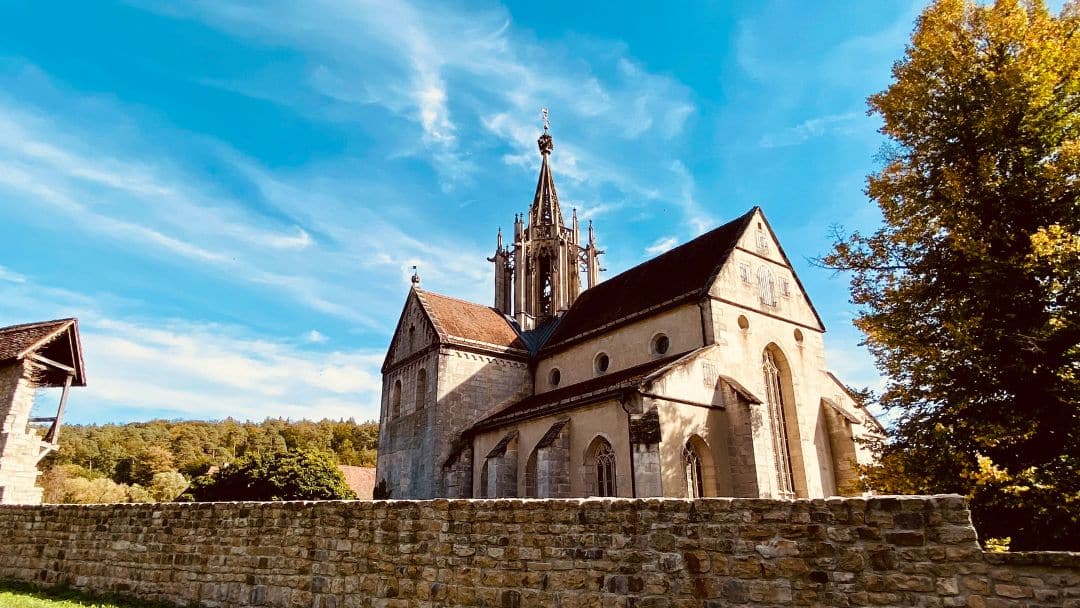
On the edge of the Schönbuch Nature Parkjust a few kilometers northwest of Tübingen, lies Bebenhausen Monastery and Palace - one of the best-preserved monastery complexes in southwest Germany. Founded in the 12th century as a Cistercian abbey, Bebenhausen impresses with its Romanesque-Gothic architecture, the beautiful cloister, the monastery church with its tracery windows and the late Gothic abbot's chapel. After the Reformation, the monastery was dissolved, served as a monastery school from 1556 and in the 19th century as an abbey. Hunting lodge of the Württemberg kings. After the end of the monarchy, the last royal couple of Württemberg lived here. From 1947 to 1952, Bebenhausen Palace was even Seat of the first state parliament of Württemberg-Hohenzollernuntil the three states of Württemberg-Hohenzollern, Baden and Württemberg-Baden merged to form the federal state of Baden-Württemberg.
💡 Tip: A visit to Bebenhausen can be perfectly combined with a City tour through neighboring Tübingen connect - the university town with its historic old town, the Neckar river front and Hohentübingen Palace is only around 6 km away.
🥾 Hiking tip: Several well-signposted paths lead from the hiking parking lot in Bebenhausen through the Schönbuch Nature Park. One Easy and beautiful round (approx. 6 km) leads through the Schönbuch Nature Park to vantage points with views of the monastery and back to the medieval village.
Bebenhausen Monastery and Palace Info
Address: In the castle, 72074 Tübingen-Bebenhausen
Opening hours: May 1 to November 1: daily 9 a.m. to 5 p.m., shorter opening hours in the winter months - please visit the website look it up.
Admission: Monastery regular € 7, reduced € 3.50, children and young people up to 18 years free; combined ticket monastery and castle (castle can only be visited with a guided tour) regular € 13, reduced € 6.50
For further information, visit the Website of Bebenhausen Monastery.
19. Zwiefalten Abbey
A baroque masterpiece with an eventful history
In the small town of Zwiefalten on the young Danube rises one of the most magnificent baroque churches in southern Germany: the former Benedictine monastery with its imposing "Our Lady" Abbey. Even at first glance at the twin-tower façade, it is clear that a detour here is worthwhile - because the interior of the church is one of the most impressive of the late Baroque period in southern Germany.
The origins of the monastery date back to the 11th century. The present church was rebuilt in the 18th century according to plans by Johann Michael Fischer. The lavish stucco work by Johann Michael Feichtmayr, the colorful ceiling frescoes by Franz Joseph Spiegler and the artistically designed altars are overwhelming. The baroque organ with its richly decorated figures is also particularly impressive.
💡 Worth knowing: After secularization in the early 19th century, the monastery was dissolved - the buildings have since been used in part as a psychiatric clinic. However, the cathedral was preserved and is now a Catholic parish church. During the National Socialist era, many patients from Zwiefalten became victims of the "Aktion T4" euthanasia program.
🥾 Tip for an excursion: Zwiefalten is located directly on the Upper Swabian Baroque Route and can be easily combined with a visit to the Wimsen Cave which is only a few kilometers away.
Zwiefalten Abbey Info
Address: Klosterhof 1, 88529 Zwiefalten
Opening hours: daily from 9:00 - 18:00
Admission: free, guided tours on request via the parish office ()
For further information, visit the Website of the Zwiefalter Minster.

20. Schönenberg Pilgrimage Church
Baroque jewel with far-reaching views over Ellwangen
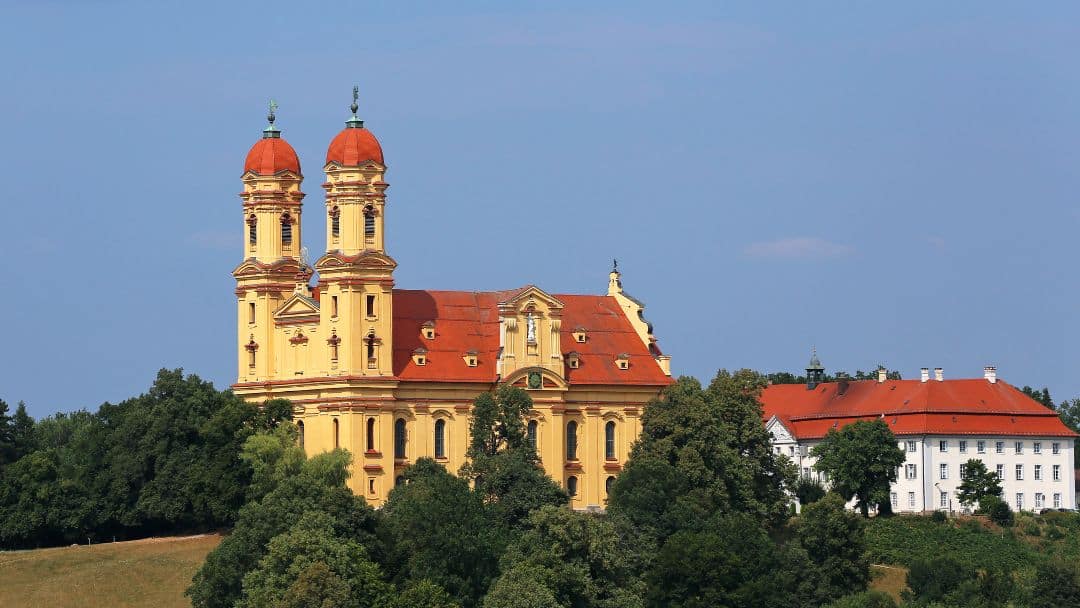
Just a few minutes outside the beautiful city Ellwangen the Schönenberg church rises on a wooded ridge. The west side offers a magnificent view of the castle, the town and the Ellwangen mountains. Inside the church is an opulent baroque work of art.
The original building, designed from 1682 by architect Michael Thumb according to the Vorarlberg Minster Scheme was completely burnt out in 1709 after being struck by lightning. Reconstruction began in the same year and was completed in 1729. The magnificent interior with altars, stucco work and ceiling frescoes dates largely from the early 18th century. The "Madonna of Schönenberg" has been the center of the Marian pilgrimage since the Thirty Years' War. The 7.5 cm tall clay figure is a replica of the Notre Dame de Foyfrom Belgium, which stands in a magnificent shrine in the Chapel of Grace.
🥾 Tip for your visit: The church is located directly on the Ellwanger Kapellenweg, which is ideal for a hike that is not just spiritual. The easy but 12.5-kilometre circular hike leads through the gently rolling hills of the Ellwangen mountains and offers wonderful views of Ellwangen, the Albtrauf and the Dreikaiser mountains.
💡 Worth knowing: The pilgrimage to Schönenberg has a long tradition and still attracts over 250,000 pilgrims every year. The great Schönenberg pilgrimage is accompanied by festive church services and concerts
Schönenberg Church Info
Address: Schönenbergs 42, 73479 Ellwangen (Jagst)
Opening hours: open around the clock.
Admission: free
For further information, visit the website.
21. Beuron Monastery
Benedictine abbey in the middle of the rocky landscape of the Danube valley
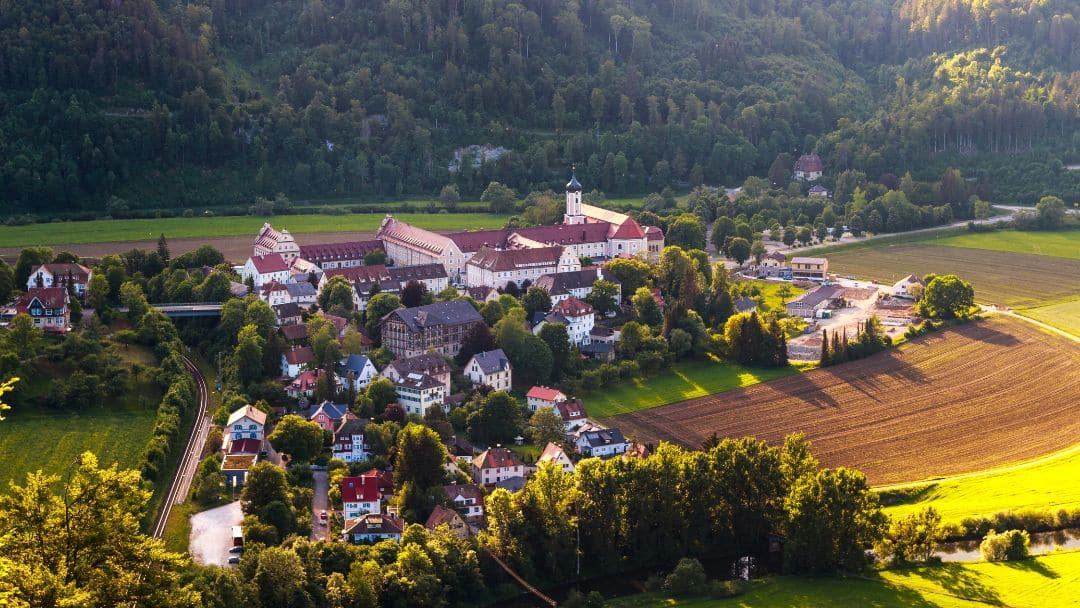
Beuron Abbey - one of the most important Benedictine abbeys in Germany - is nestled in the imposing rocky landscape of the Upper Danube Valley. Founded in the 11th century as an Augustinian canon monastery, it was revived in the 19th century and developed into the spiritual center of the so-called Beuron Art Schoolwhich influenced Catholic church architecture far beyond the region. Beuronese art was a sacred precursor of Art Nouveau and is characterized by clear lines and geometric pictorial compositions.
The baroque monastery complex impresses with its harmonious architecture and the rich interior of the abbey church of St. Martin, which is dominated by Byzantine-inspired frescoes and mosaics. Even today, the abbey is still an active monastery with monastic life, a monastic bookshop and a simple monastery restaurant.
🥾 Hiking tip:
For experienced hikers, the almost 15 km long premium hiking trail Danube Wave Tour "Eichfelsen Panorama" a circular hike through the wild and romantic Danube valley with spectacular views, mysterious caves and varied paths. The starting and finishing point is the Parking lot at Beuron Monastery. On the way you will pass the viewpoints Oak rock and Rough stone which are among the most beautiful panoramic points in the Danube gorge.
☕ Tip for afterwards: There is a café and the "Pelikan" restaurant right next to Beuron Monastery. If you want to try a real Swabian specialty, be sure to order a slice Danube wave - the classic sheet cake with sour cherries, buttercream and chocolate icing is not only related to the hike by name, but is also a real treat after the tour.
💡 Tip for all those who like it more cozy:
The viewpoints can also be reached without a long hike. From the Parking lot Eichfelsen there are only about 800 meters to the Eichfelsen viewpoint. And from the Rauher Stein parking lot in Irndorf (right next to the Rauher Stein hiking lodge), you can reach the viewpoint of the same name in just a few minutes. Both spots offer a fantastic view of the Danube valley - without a strenuous climb.
Beuron Monastery Info
Address: Archabbey of St. Martin zu Beuron, Abteistraße 2, 88631 Beuron
Opening hours: Church open daily, 5:00 am - 8:00 pm (as of September 2025)
Admission: free
Note: Please respect the monks' prayer times and the peace and quiet of the monastery.
For further information, visit the Website of Beuron Archabbey.
22. Lorch Monastery
The former Staufer burial site with a panoramic view of the Rems Valley
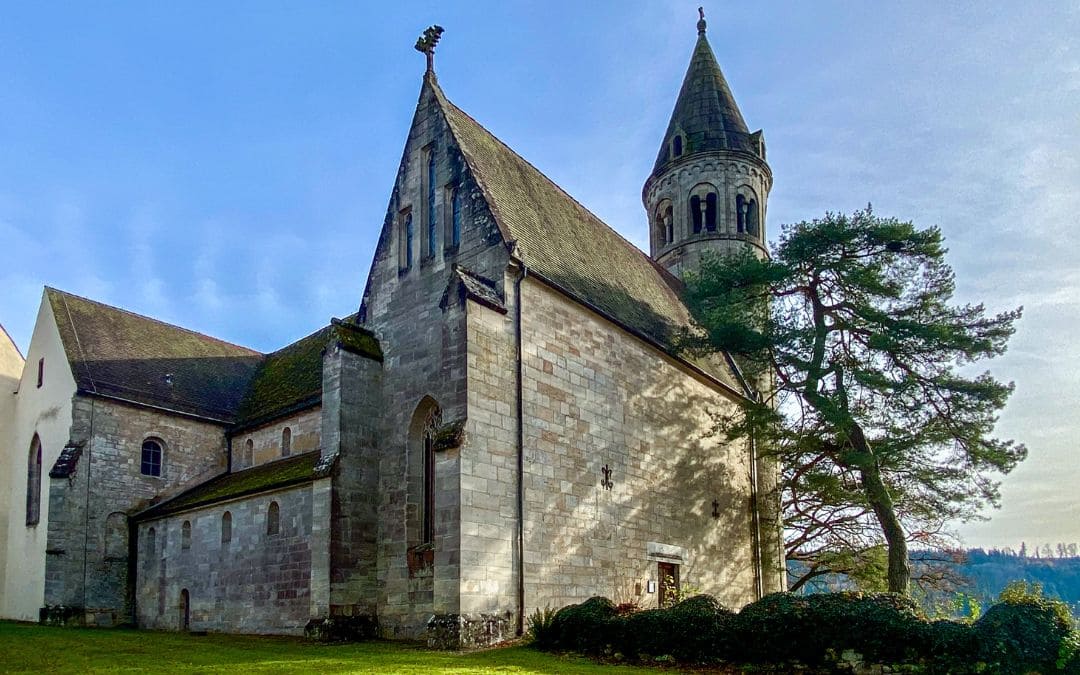
Visible from afar Lorch Monastery picturesquely situated on a hill above the Rems Valley. The former Benedictine abbey was founded around 1100 by the Staufern one of the most important ruling dynasties of the Middle Ages. Today, the impressive complex is a place of history and tranquillity - and a popular excursion destination.
Particularly worth seeing is the Romanesque church with Gothic elements, the extensive monastery garden and the monumental Staufer panoramawhich the Lorch artist Hans Kloss worked on from 1998 to 2002. Over 30 meters, it tells the story of the Hohenstaufen dynasty - from Frederick Barbarossa to Frederick II.
During the Nazi era, the monastery was used by the Nazis for numerous propaganda events as part of their worship of the Hohenstaufen dynasty. Today it stands for a completely different spirit: The historic buildings house one of the most beautiful nursing homes in Baden-Württemberg a place of care and humanity in a location steeped in history.
Directly in front of the monastery grounds is a Reconstructed Limes watchtower - a reference to the region's Roman past. The Upper Germanic-Raetian Limeswhich ran very close by, is now part of the UNESCO World Heritage Sites in Germany.
💡 Worth knowing:
The monastery church houses the Burial sites of several members of the Staufer familyincluding those of Frederick I of Swabia and his wife Agnes, as well as Irene of Byzantium, the daughter-in-law of Frederick Barbarossa.
🥾 Hiking tip:
An beautiful circular hike leads for approx. 11 km from Lorch Monastery along the Limes to the Schiller grotto and about the Rogue blade, past redwood trees back again.
👉 City tip: Just 7 kilometers from the monastery lies the oldest Staufer town of all - Schwäbisch Gmünd, with one of the most beautiful market squares in southern Germany and an impressive cathedral.
Lorch Monastery Info
Address: Klosterstraße 2, 73547 Lorch
Opening hours: March - October: Wednesday to Sunday and public holidays 10:00 - 18:00, November - February: Wednesday to Sunday and public holidays 13:00 - 17:00
Admission: Adults €6, reduced €3, family ticket €15 (incl. Staufer panorama)
For further information, visit the Website of Lorch Monastery.
Caves of the Swabian Alb
Fascinating insights into the history of the earth and humanity
The Swabian Alb is considered the region with the most caves in Germany - over 2,800 caves have been recorded here to date. Many of them have been created by the typical karst landscape, in which water has carved its way through the limestone. Today, you can explore some of these caves on secured paths - they offer impressive stalactite formations, underground rivers or even an insight into the Ice Age art of the first humans.
A visit to the show caves near Sonnenbühl (Bärenhöhle and Nebelhöhle) and the Laichinger Tiefenhöhle - Germany's deepest accessible shaft cave - is particularly exciting for children. Archaeology and culture enthusiasts will love the UNESCO-protected sites in the Ach and Lone valleys. Some of the oldest works of art in human history were discovered here and can now be admired in modern museums in the region.
23. Bären- und Nebelhöhle near Sonnenbühl
Two of the most beautiful show caves in the Swabian Alb
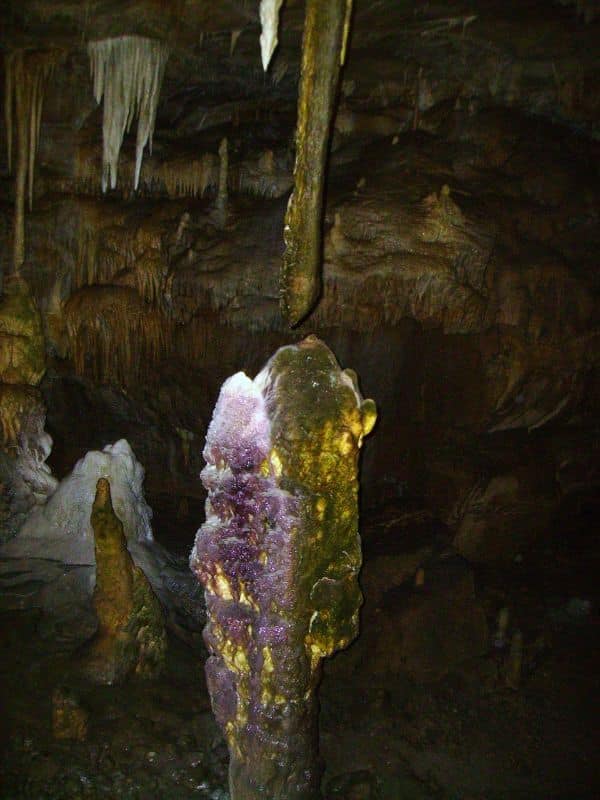
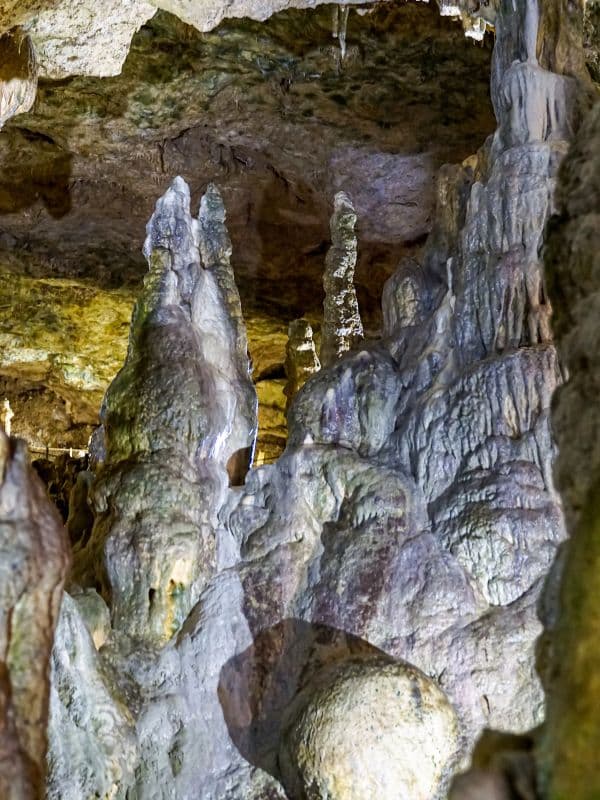
In the karst area around Sonnenbühl in the Central Swabian Jura there are two fascinating stalactite caves, which are among the most popular excursion destinations in the region: the Bear cave near Erpfingen and the Nebelhöhle near Genkingen. Both caves were formed over many thousands of years by calcareous water and offer impressive stalactite formations in bizarre shapes.
The Bear cave owes its name to the numerous bone finds of Ice Age cave bears that once lived here. It is almost 250 meters long and particularly family-friendly designed. The leisure park is right next door Dreamland in the bear cavewhich is perfect for a day trip with children.
The Nebelhöhlejust a few kilometers away, is somewhat larger, more natural and has a particularly mystical effect - not least due to the legendary stories that surround it. Inside, huge halls, pillars and stalactite curtains await you, artfully illuminated in changing light.
🥾 Hiking tip:
The two caves can be connected on a beautiful hike - for example via an approximately 10 km long Circular routewhich also includes Lichtenstein Castle - an absolute highlight on the Alb! - and leads through forests and juniper heaths.
Bear cave info
Address: Bear cave, 72820 Sonnenbühl
Opening hours: April - October: daily 9:00 - 17:30, November - March: Sat, Sun & public holidays 9:00 - 17:00,
(Winter break from December to February - current information on the website)
Admission: Adults €7, reduced €6, children €5, family ticket €17
For further information, visit the Website of the bear cave.
Fog cave info
Address: Nebelhöhle 1, 72820 Sonnenbühl-Genkingen
Opening hours: April - October: daily 9:00 - 17:30, November - March: Sat, Sun & public holidays 9:00 - 17:00,
(Winter break from December to February - current information on the website)
Admission: Adults €7, reduced €6, children €5, family ticket €17
For further information, visit the Website of the Nebelhöhle.
24. Wimsen Cave
Germany's only show cave accessible by boat
The Wimsen Cave, also called Friedrich's Cave is a true natural wonder and a highlight for anyone who wants to experience the Swabian Alb from the water. It is the Germany's only show cave accessible by boat - absolutely unique.
At the foot of a limestone wall, this is where the Zwiefalter Aachwhich makes its way from the inside of the cave to the outside. You can explore the first 70 meters of the cave on a guided tour in a small electric boat. The moment when you emerge from daylight into the mysterious darkness of the stalactite world is particularly impressive.
On the boat trip into the cave, the guide will tell you exciting facts about the geology and history - and that the constant temperature is perfect for storing Christmas stollen. The famous Wimsen cave gallery can be found at BeckaBeckwhich operates many branches in the Swabian Alb.
Right next door, the historic Friedrichshöhle Inn to take a break: Organic, regional & particularly tasty. I had Swabian sausage salad with a beer dressing (!) and rosemary potatoes. Sounds unusual - but it was really good and didn't taste like beer at all.
💡 Worth knowing:
The cave is named after Duke Friedrich I of Württembergwho was the first to enter the cave on a raft in 1803. The total explored length of the cave today is over 1,200 meters, but only a small part is open to the public.
📍Tip: Combine the excursion with a visit to Zwiefalten Minster, a masterpiece of Upper Swabian Baroque, just 4 kilometers away. Beer lovers will get their money's worth at the Zwiefalter Klosterbräu brewery, which also offers tours.
🥾 Hiking tip:
Around the cave runs the approximately 9 km long Premium hiking trail highly valuedwhich takes you through idyllic valleys, forests, juniper heaths and past Ehrenfels Castle. The green nature and the babbling brooks, springs and small waterfalls make the area particularly enchanting. The hike starts directly at the parking lot of the Wimsen cave and is moderately difficult tour (approx. 3 hours) can be easily managed with normal fitness - sturdy footwear is required.
Wimsen Cave info
Address: Wimsen 1, 72534 Hayingen
Opening hours: April - October daily 10:00 - 18:00 (depending on weather conditions), boat trips only when the water level is suitable - information on the website
Admission: Adults 7€, children 6 - 12 years 6€, children 2 - 5 years 5€. Online booking recommended.
For further information, visit the Website of the Wimsen Cave.
25. Laichingen Deep Cave
Germany's only shaft cave converted into a show cave
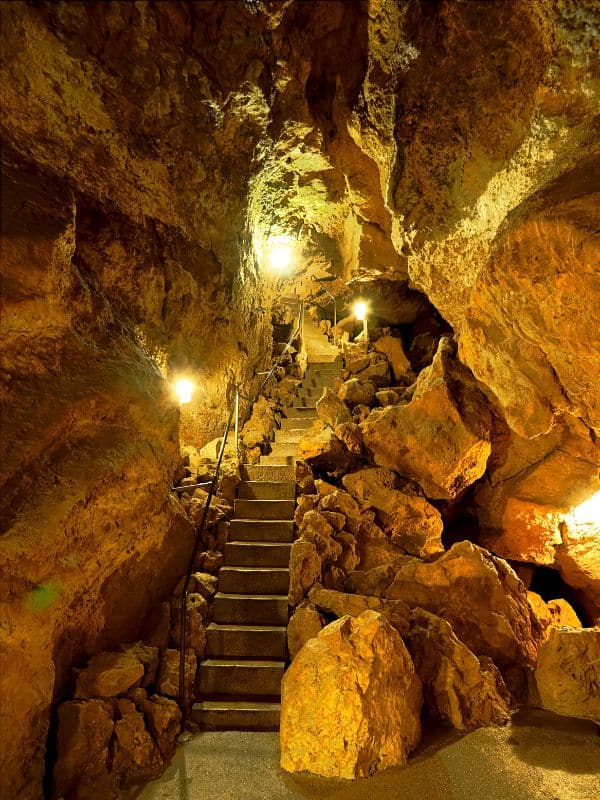
If you want to enjoy the view not only over the Alb, but also in The Laichingen Deep Cave is just the place for anyone who wants to throw themselves into it: the impressive shaft cave leads steeply into the depths - you can explore up to 80 meters on secured paths. An extraordinary experience for anyone who is not claustrophobic and has a sense of adventure!
The cave was discovered in 1892 by the Laichingen sand digger Johann Georg Mack. Today, it is the only shaft cave in Germany that has been developed into a show cave - with an approximately 330 m long path that leads visitors 55 m into the depths via iron stairs. Although there are only a few stalactites in the cave, it is very interesting, as you can clearly see the formation of the storeys and the rock structure of the Alb.
The temperature in the cave is around 8°C all year round - so you should definitely bring a jacket when you visit.
💡 Worth knowingShaft caves are formed by vertical water drainage in karstified limestone - unlike the horizontal cave systems that you also find in the Swabian Alb, where the water seeps into the rock along impermeable layers. Both types of caves are formed by the slow dissolution of the rock by acidic water.
🥾 Hiking tip: The 11.5 km long trail begins at the Laichingen deep cave. karstic hiking trail. It offers varied insights into the karst landscape: cave openings, limestone rock formations and typical vegetation of the Swabian Alb alternate with each other.
Laichingen deep cave info
Address: Höhleweg 220, 89150 Laichingen
Opening hours: from Palm Sunday to the end of the fall vacations in Baden-Württemberg daily from 10 a.m. to 6 p.m. (admission until 5:30 p.m.).
Admission: Adults 6€, children up to 16 years 4€.
For further information, visit the Website of the Laichingen Deep Cave.
26. UNESCO World Heritage Caves in the Ach and Lone Valleys
Discover the oldest art of mankind in the Swabian Jura
It's hard to believe that some of the oldest works of art and musical instruments in the world do not come from Egypt or Mesopotamia - but from the Swabian Alb! In the caves of the Ach and Lonetals is where the first modern humans in Europe lived around 40,000 years ago. Their ornate carvings and flutes are among the oldest cultural heritage of mankind and were recognized in 2017 as a "Caves and Ice Age art of the Swabian Alb" on the UNESCO World Heritage List.
In the Achtal near Blaubeuren is above all the Hohle Fels near Schelklingen is impressive: here the world-famous Venus vom Hohle Fels - the oldest known depiction of a human -, several flutes made of bird bone and mammoth tusk as well as animal figurines such as a horse's head or waterfowl. The cave can be visited as part of a guided tour, the original finds are on display in the Prehistoric Museum Blaubeuren (URMU) issued.
In the Lone Valley northeast of Ulm, is particularly worth a visit to the Stadel cave on the Hohlenstein: In 1939, archaeologists discovered the enigmatic Löwenmensch - a 40,000-year-old figure made of mammoth ivory, half animal, half human, which is now on display in the Museum Ulm can be seen here. Also in the Lone Valley is the Bockstein Cave. The site where numerous tools and pieces of jewelry from the Neanderthal period were found. The Vogelherd Cave,from which some of the most spectacular finds originate, is unfortunately permanently closed.
💡 Tip: Some of the most beautiful Ice Age figures - such as the mammoth or the wild horse from the Vogelherd Cave, - are in the Museum of Ancient Cultures (MUT) in Tübingen to marvel at.
🥾 Hiking tip: A beautiful circular hike leads along the Ice Age Trail Neanderthal Trail from Lindenau to the UNESCO World Heritage caves of the Lone Valley (approx. 12 km)
Hohle Fels info
Address: Hohle-Fels-Weg, 89601 Schelklingen (access from the hiking parking lot near the cemetery)
Opening hours: from April to October Saturday and Sunday 11:00 - 17:00, Friday and public holidays 14:00 - 17:00, extended opening hours during the summer vacations, guided tours on Saturdays at 11:45 (please check the website)
Admission: regular 4,50€, children/young people up to 17 years 2€, reduced 3€
Click here for the Website of the Hohle Fels.
Stadel Cave (Hohlenstein) Info
Address: Hikers' parking lot Lindenau, 89192 Rammingen; from here a path leads down into the Lone Valley. The caves (Stadel on the left, Bärenhöhle on the right) are on the right-hand side of the valley.
Opening hours: freely accessible
Click here for the Website of the Hohlenstein Caves.

Towns in the Swabian Alb
Half-timbered houses, history and lively old towns with a special flair
Some of the most beautiful towns in southern Germany are hidden between striking rock formations and tranquil juniper heaths in the Swabian Alb. Here, lovingly restored half-timbered houses meet mighty cathedrals, baroque monasteries meet medieval town gates - and the cultural offerings never cease to amaze. Whether university town, place of pilgrimage or former residence: the towns in the Alb are as diverse as the surrounding landscape. Perfect for anyone who likes to combine their nature experiences with a dash of history and regional delights.
27. Tübingen
Half-timbered romance, student flair and one of the oldest universities in Germany
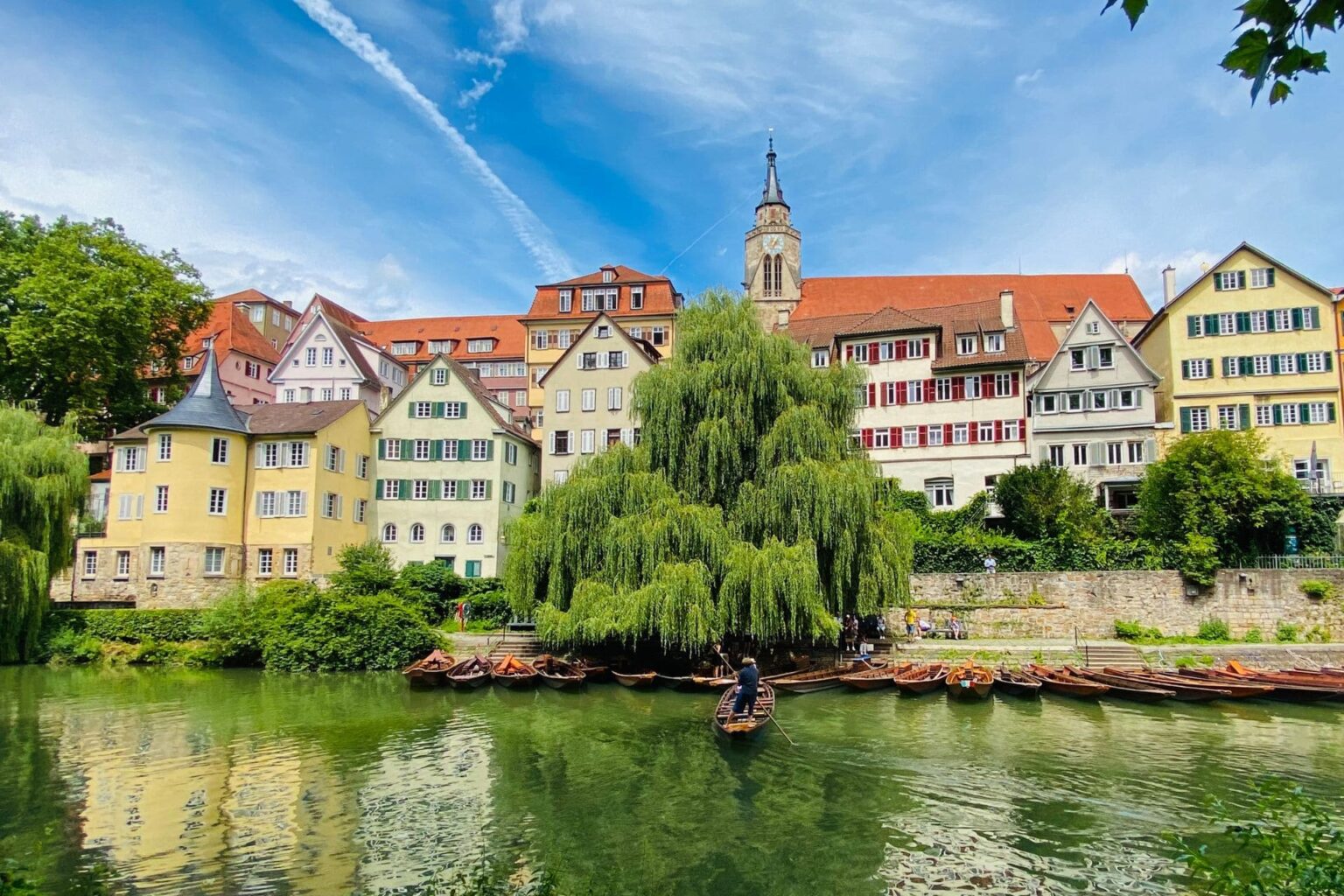
Tübingen is one of the most charming cities in Baden-Württemberg - rich in tradition, lively and characterized by over 500 years of university history. The old town with its narrow alleyways, colorful half-timbered houses and the picturesque Neckar river front is a real eye-catcher. On the market square the imposing town hall with its painted façade and the neo-Gothic Hölderlin Tower on the banks of the Neckar make for particularly photogenic backdrops. Towering high above the city is the Hohentübingen Castle from whose inner courtyard you have a wonderful view over the city.
The Eberhard Karls University , founded in 1477, is one of the oldest universities in Germany. It still shapes the cityscape today - every third inhabitant of Tübingen is a student. This ensures a lively cultural life, many cafés and alternative stores.
💡 Tip: If you have a little more time, it's worth making a detour to the Bebenhausen Monastery and Palacewhich is located just a few kilometers outside the Schönbuch Nature Park. The medieval monastery complex and the former hunting lodge of the Württemberg kings are among the highlights of the region.
🥾 City hiking tip: In my article Tübingen - city of flowers, poets and cyclists I will take you on a tour of the old town, combined with a climb up to Hohentübingen Castle. There you will also find a Google Maps map, which you can download to your cell phone for your city tour. I present Tübingen's most beautiful museums in the article Museums in Tübingen: 7 Cultural Sites Between History and the Present to you.
🎭 A special event is the punt race on the Neckar, which takes place every year Corpus Christi and attracts thousands of visitors. Also popular is the Umbrian-Provençal market in September, when traders from the twin towns bring the Italian and French way of life to the old town.
Tübingen Info
Highlights Tübingen:
- Hohentübingen Palace with Museum of Ancient Cultures
- Market square with magnificent town hall
- Hölderlin Tower
- Neckar front.
- Punt trips
- Bebenhausen Monastery and Palace
Address Tourist Information: An der Neckarbrücke 1, 72072 Tübingen
Opening hours Tourist Information: Monday - Friday 10:00 - 18:00, Saturday 10:00 - 14:30, Sunday 11:00 - 14:30
For further information, visit the Tourism website of Tübingen.
Parking garage recommendation: Neckar parking garage (near the Neckar bridge), Wöhrdstraße 11, 72072 Tübingen
€0 e-book tip
My e-book Old Town Magic in Germany includes five historic old town walks with maps and concise information.
28.Ulm
Rich in tradition, cosmopolitan and spectacular: Ulm delights with its cathedral, Danube and lots of charm
Ulm is a city of superlatives - in more ways than one. World-famous is the Ulm Minster with its 161.53 meter high tower, the highest church tower in the world. Anyone who masters the 768 steps to the viewing platform will be rewarded with a breathtaking panoramic view over the city, the Danube and, on a clear day, as far as the Alps. But Ulm has much more to offer than just its famous landmark.
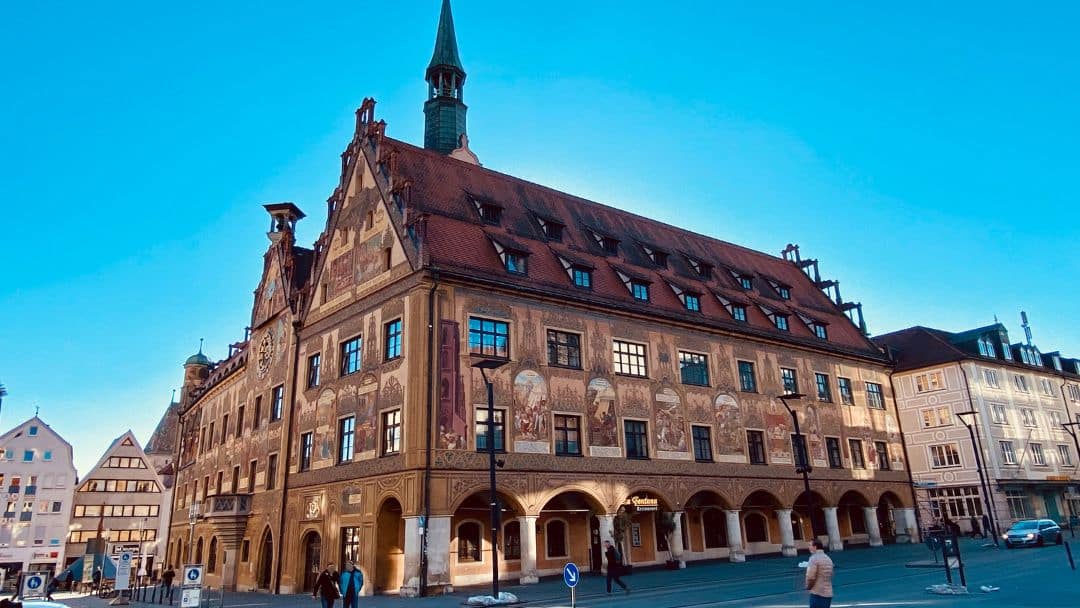
In the picturesque old town, the Fishermen's Quarter with its crooked half-timbered houses, narrow alleyways and small bridges. Here you will also find the Crooked housewhich even made it into the Guinness Book of Records due to its steep incline - today it houses a romantic hotel. In my opinion, the most beautiful building in the old town is the Renaissance town hall with impressive facade paintings and an astronomical clock. The Danube is a wonderful place to walk or cycle, for example along the riverside promenade to the Wiblingen Monastery with its magnificent baroque library.
Ulm is culturally famous with the Museum Ulm, Edwin Scharff Museum and the Kunsthalle Weishaupt is also well positioned. Particularly exciting: a new exhibition on the UNESCO World Heritage Site "Caves and Ice Age Art of the Swabian Alb" with original finds from the caves in the Lone Valley is being created in the Ulm Museum (currently closed for renovation! As of September 2025). Highlights include the 40,000-year-old Lion man from the Stadel cave (until October 2025, he is in the neighboring art gallery weishaupt to see. If you want to delve deeper, you can easily take a day trip from Ulm to the Lone Valley. You can find more information in the section on the caves of the Swabian Alb.
💡 Worth knowingUlm was once a free imperial city and the birthplace of the famous physicist Albert Einstein - he is commemorated today by a monument on the station square, which depicts his head as a steel sculpture.
🥾 Tip: : If you still have some energy left after a stroll through the city, you can enjoy the Ulmer Höhenweg (approx. 12 km) discover the green side of the city - with wide views over the Danube valley and nice places to stop for refreshments along the way.
🎭 One of the highlights of the year is the Swim Monday on the penultimate Monday in July, when the Lord Mayor traditionally renews his oath of allegiance - celebrated with a parade, water festival and town festival. Also legendary is the Nabada, where countless colorfully decorated boats and rubber animals float down the Danube on Schwörmontag. Every four years, the historic Fishing tournament where disguised engravers compete against each other on boats - a spectacle with a centuries-old tradition.
Ulm Info
Highlights of Ulm:
- Ulm Minster
- Old town with magnificent town hall and fishermen's quarter
- Danube promenade
- Ulm Museum (with UNESCO finds)
- Kunsthalle Weishaupt
- Wiblingen Monastery
Address Tourist Information: Münsterplatz 50, 89073 Ulm
Opening hours Tourist Information: Monday - Friday 09:30 - 18:00, Saturday 09:30 - 16:00, Sunday 11:00 - 15:00
For further information, visit the Tourism website of Ulm.
Parking garage recommendation : Parking garage at the town hall (centrally located, 3 minutes walk to the cathedral), Neue Straße 83, 89073 Ulm
29. Kirchheim unter Teck
Half-timbered town with residential flair on the Albtrauf
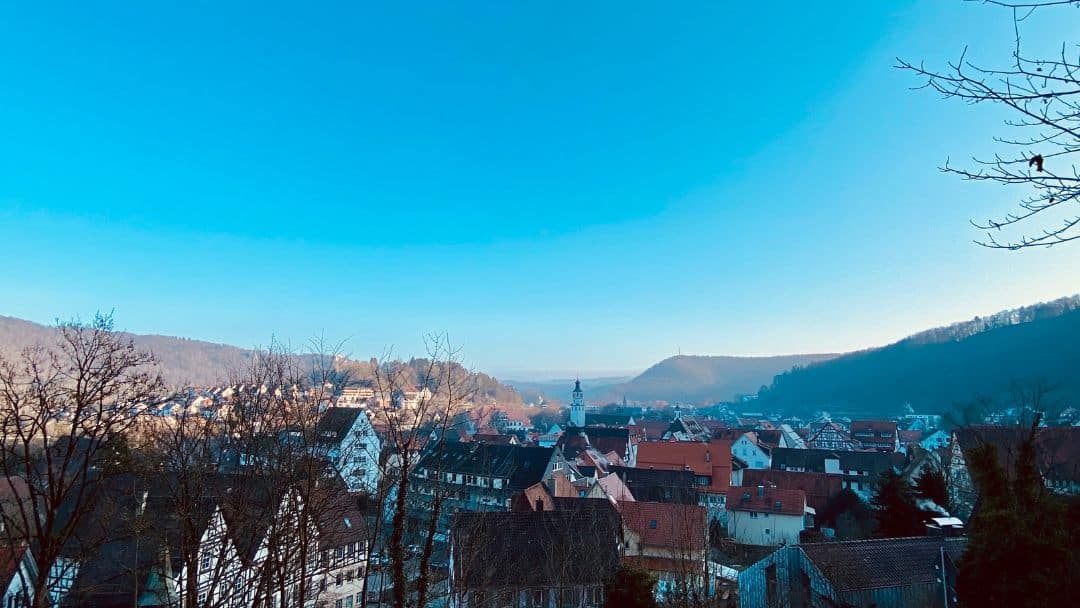
Kirchheim unter Teck is a real insider tip for anyone who loves historic small towns with atmosphere. The lovingly restored old town is located on the German Half-Timbered Road and is one of the most beautiful half-timbered ensembles in Baden-Württemberg - with numerous cafés, owner-run stores and small museums. The focal point is the market square with the imposing 16th century town hall and the town church.
A particular highlight is the Renaissance palace, which was once the widow's residence of the Württemberg duchesses. The most famous widow to reside here was Franziska von Hohenheim. Today you can visit the historic rooms with original furniture and paintings - an authentic insight into the everyday life of princes in past centuries.
Kirchheim unter Teck has also produced a well-known literary name: Max Eythengineer, draughtsman and writer, was born here in 1836. His birthplace - a magnificent half-timbered building - can be visited today. It houses the tourist information office as well as a small exhibition on the life and work of the versatile author.
🥾 Beautiful walking and hiking trails around Kirchheim invite you to explore nature - for example to the nearby Teck Castlewhich you can reach in around 30 minutes on foot from the Hörnle parking lot. If you have more time, you will be spoiled for choice with the many tours in this beautiful area. On the Premium hiking trail "hochgehadelt" you will experience some of the most beautiful vantage points in the Alb with the Breitenstein, Teck Castle and the Rauber ruins.
🎭 A living custom is the Haft- ond Hokafeschtwhich attracts visitors from all over the region to the old town every year on the last weekend in June with music, regional specialties and a colourful supporting program. During the Advent season, the town lights up with the romantic Christmas market around Kirchheim Castle in festive splendor.
Kirchheim unter Teck Info
Highlights Kirchheim unter Teck:
- Old town with many well-preserved half-timbered houses
- Half-timbered town hall
- Max Eyth House
- Municipal Museum in the Kornhaus
- Teck Castle
Address Tourist Information (in the Max-Eyth-Haus): Max-Eyth-Str. 15, 73230 Kirchheim unter Teck
Opening hours Tourist Information: Monday-Friday: 10:00 - 17:00, Saturday: 10:00 - 14:00
For further information, visit the Website of the tourist information office.
Parking garage recommendation: Krautmarkt underground parking garage (directly on the market square), Alleenstraße 1 - 3, 73230 Kirchheim unter Teck

30. Blaubeuren
Medieval monastery town with UNESCO World Heritage Site
Blaubeuren is idyllically situated at the foot of the Swabian Alb and is inextricably linked with the mystical Blue pot whose deep blue waters have inspired numerous legends (described in more detail in the Category Caves further up in this article). Directly above it rises the former Benedictine monastery Blaubeurenwhich was founded in the 11th century. Particularly worth seeing is the late Gothic choir with the world-famous Blaubeuren high altar (around 1500), a masterpiece of Swabian carving.
Another highlight is the Prehistoric Museum Blaubeuren (urmu). Here you can immerse yourself in the Stone Age and discover unique original finds from the caves of the Swabian Alb, which have been part of the UNESCO World Heritage Site "Caves and Ice Age Art in the Swabian Jura" belong to. The world-famous Venus vom Hohle Fels - a 40,000-year-old ivory figure - can be admired here in its original form. The nearby caves in the Achtal valley, such as the Hohle Fels or the Geißenklösterle are important sites that are part of the UNESCO World Heritage and make the area around Blaubeuren a central place in human history.
A stroll through the old town awaits you with lovingly restored half-timbered houses, small cafés and the picturesque market square. A detour to the Blautopf is a must - it is simply part of a visit to Blaubeuren.
🥾 A visit to Blaubeuren can easily be combined with a Hike in the Achtal valley or a visit to the Hohle Fels and the Geißenklösterle.
🎭 A cultural highlight is the Summer stage at the Blautopf, which attracts numerous visitors from all over the region every summer for several weeks with concerts, theater and cabaret.
Blaubeuren Info
Address Tourist Information: Kirchplatz 10, 89143 Blaubeuren
Opening hours Tourist Information: in summer Monday - Sunday 10:00 - 17:00, in winter Monday - Friday 10:00 - 12:00, Saturday and Sunday 10:00 - 16:00
For further information, visit the Website of the tourist information office.
Highlights of Blaubeuren:
- Blautopf - legendary karst spring
- Benedictine monastery in Blaubeuren with high altar
- Prehistoric Museum (urmu) with the Venus of the Hohle Fels
- UNESCO caves in the Achtal (Hohle Fels, Geißenklösterle)
- Old town with half-timbered houses and market square
Parking lot recommendation: Dodelweg (large, paid parking lot near the city center): Dodelweg, 89143 Blaubeuren
31. Ellwangen
Baroque residential city with a monastic past
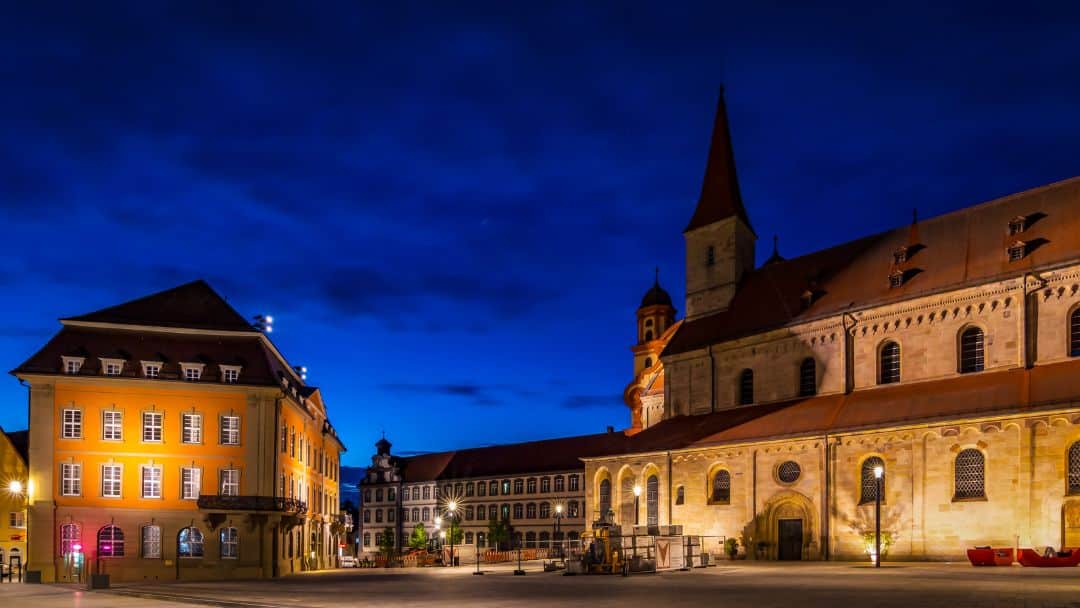
Ellwangen an der Jagst looks back on over 1250 years of history. The town was founded in the 8th century as a Benedictine abbey and later developed into an important residential town. To this day, the Baroque collegiate church of St. Vitus which is considered one of the most beautiful baroque churches in southern Germany.
Perched on the castle hill is Ellwangen Castle, once the seat of the prince provosts. Today, it houses a museum that tells the eventful history of the region - from the monastery's foundation to the prince provosts' period of residence to the present day.
As you stroll through the old town, you will discover magnificent town houses, narrow alleyways and the baroque market square with the town hall and basilica. A visit is particularly attractive in spring, when the city is in full bloom during the Ellwangen Horse Days becomes the center of equestrian sport.
🎭 The most important festival is the Kalter Markt (literally "cold market"), which is traditionally celebrated for four days from the second Sunday in January and has been one of the most important horse markets in southern Germany since the Middle Ages. Make a note now: 2026 will see the State Garden Show in Ellwangen .
Ellwangen Info
Address Tourist Information: Spitalstraße 4, 73479 Ellwangen (Jagst)
Opening hours Tourist Information: Monday - Friday 09:00 - 17:00, Saturday 09:00 - 13:00, exceptions are noted on the website.
For further information, visit the Website of the tourist information office.
Highlights of Ellwangen:
- Collegiate Church of St. Vitus (baroque basilica)
- Ellwangen Castle with museum
- Historic market square and old town
- Ellwanger Pferdetage (annual traditional horse market)
Parking lot recommendation: For the castle tour, use the parking lot at the castle, Schloss ob Ellwangen 13, 73479 Ellwangen (Jagst); for the city tour, we recommend the P2 Parkpalette Innenstadt (address for navigation: Schöner Graben 9, 73479 Ellwangen), as the first two hours with a parking ticket are free of charge.
menszner@Getty Images via canva.com
32. Rottweil
The oldest town in Baden-Württemberg with medieval flair
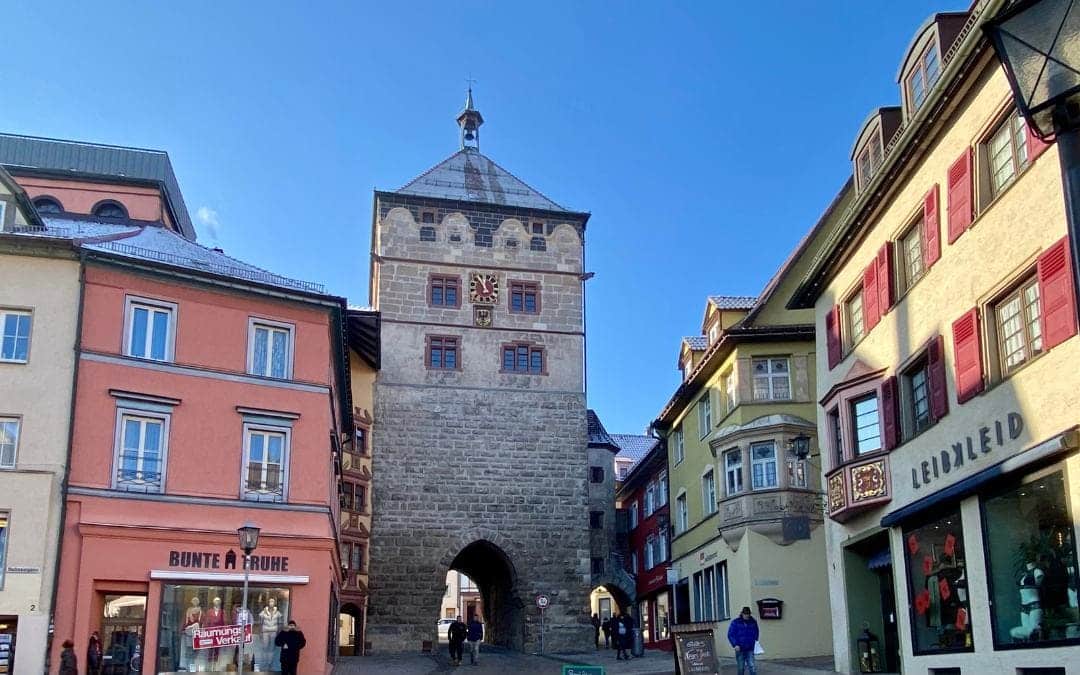
The oldest city in Baden-Württemberg looks back on over 2,000 years of history - from the Roman settlement of Arae Flaviae to the lively small town of today. Magnificent town houses with bay windows, medieval towers and picturesque alleyways await you in the old town. Particularly worth seeing are the Schwarzes Tor ("black gate")the Old Town Hall (Altes Rathaus) and the city's churches.
Rottweil bears the nickname "city of towers" - from the medieval city towers to the futuristic Thyssenkrupp test tower. At 246 meters high, it is one of the tallest buildings in Germany, and from its visitor platform at a height of 232 meters, it offers a breathtaking panoramic view over the Black Forest, the Alb and, on a clear day, as far as the Alps.
🎭 Cultural highlight: Rottweil is famous for its Fasnet, one of the most traditional Swabian-Alemannic carnivals. The highlight is the Narrensprung (literally "Fools' Leap"), which attracts thousands of spectators to the old town on Fasnetsmontag and Fasnetsdienstag (carnival Monday and carnival Tuesday), when hundreds of jesters jump through the streets in their historic costumes.
Rottweil Info
Address Tourist Information: Hauptstraße 21, 78628 Rottweil
Opening hours Tourist Information: Opening hours vary depending on the time of year. You can find them on the Website of the tourist information office.
For further information, visit the Website of the tourist information office.
Highlights of Rottweil:
- Black gate
- Main street with beautiful old houses
- Holy Cross Minster
- Dominican Church
- TK Elevator test tower
Parking lot recommendation: For the city center I recommend parking P6 in the Stadtgrabenstraße - Centrally located and inexpensive. There is also a paid parking lot at the TK Testturm site.
Rocks and Viewpoints
The Swabian Alb is famous for its striking Albtrauf,the steeply sloping edge of the low mountain range. From there, breathtaking views open up over the Swabian Alb, the foothills of the Alb and, on a clear day, even as far as the Alps. You often have the best views from rocky outcrops or towers, which can be reached on short or longer hikes.
Whether you prefer spectacular panoramas, enchanted rocks or historic lookout towers on mountain peaks - the Swabian Alb offers hiking trails for all abilities. Even less ambitious hikers will find varied tours that lead to impressive viewpoints without too much effort. The following tips present some of the most beautiful destinations that you can easily reach via marked hiking trails and nearby hiking parking lots.
33. Zeller Horn
Panoramic view of Hohenzollern Castle
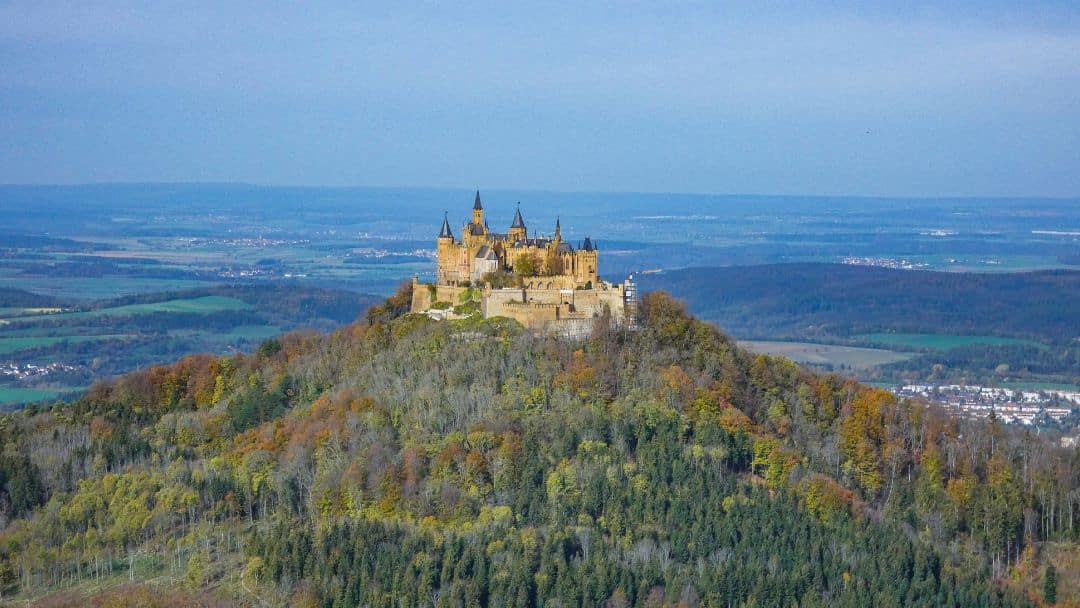
The Zeller Horn is probably the most famous vantage point in the Swabian Alb - no wonder, because from here you have the most beautiful view of the imposing Hohenzollern Castle, which sits picturesquely on its cone-shaped mountain. The viewpoint is located on the Albtrauf above Albstadt-Onstmettingen and is easily accessible on foot.
🥾 Hiking tip: From Parking lot at Zollersteighof you walk only about 20 minutes to the Zeller Horn. Please note; there are two options here. Variant 1 follows the Zollernburg-Panorama eaves trail. Here you first descend into the forest, followed by a steep ascent to the Zeller Horn. Variant 2 is a Wide, level path from the parking lot in a north-easterly direction, which is also suitable for inexperienced hikers. At a crossroads, continue left to the Zeller Horn. If you want to hike more, we recommend the Zollernburg Panorama Trailone of the most beautiful hiking trails in Germany. The total 16-kilometer tour takes you along the edge of the eaves with ever-changing views of Hohenzollern Castle. If you don't want to walk the whole route, you can do the loop in two shorter stages divide.
💡 Extra Tip: The view of Hohenzollern Castle is particularly atmospheric at sunrise or sunset, when the silhouette of the castle shines in golden light - an unforgettable picture.
Parking: Parking lot Zollersteighof, Zollersteige 5, 72379 Hechingen
34. Breitenstein
Far-reaching views over the Alb foothills to the Alps
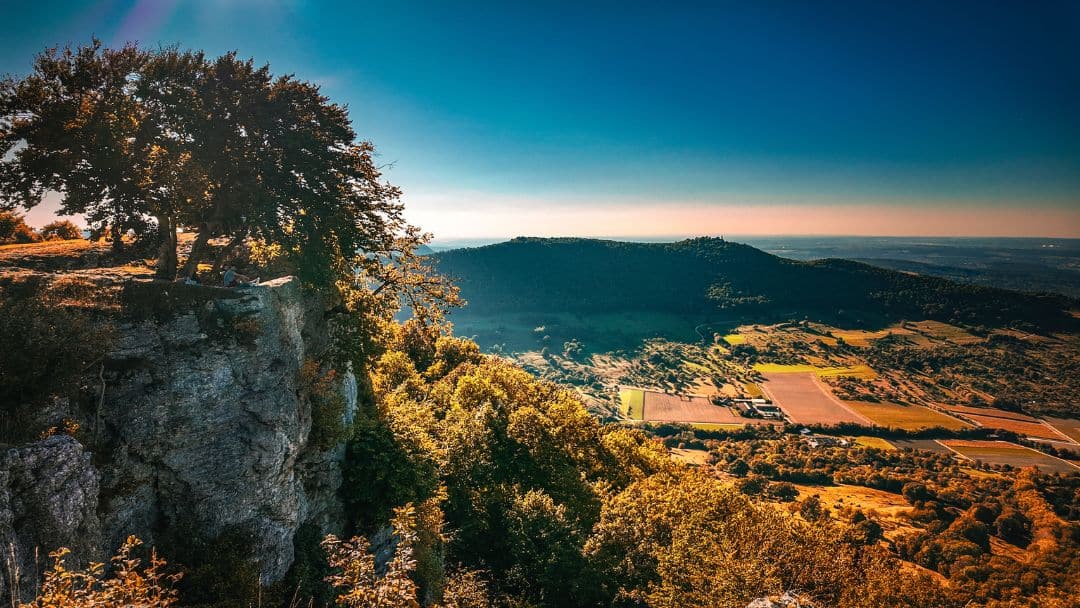
The Breitenstein near Ochsenwang is one of the most popular vantage points in the Swabian Alb. The striking rocky outcrop on the Albtrauf offers you a spectacular panoramic view over the foothills of the Alb and even as far as the Alps on a clear day. The steep cliff edge, which juts out freely over the landscape, is particularly impressive - a perfect photo spot.
🥾 Hiking tip: The easiest way to reach the Breitenstein is from the Breitenstein hiking parking lot near Ochsenwang. From here, it is only a few minutes' walk to the rock. If you want to take a longer tour, you can start from the Hörnle hiking parking lot and follow the Premium hiking trail "hochgehadelt" combine several highlights in one tour: Teck Castle, the Gelber Fels viewpoint, the Rauber ruins and, as the icing on the cake, the Breitenstein.
💡 Extra Tip: The Breitenstein is not far from the Randecker Maar and the Schopflocher Moor, two natural phenomena in the Swabian Alb that you should not miss (see section Natural wonders of the Swabian Alb further up in this article)
Parking: Hiking parking lot Breitenstein, 73268 Ochsenwang
35. Schönberg Tower ("Onderhos") near Pfullingen
An observation tower with cult status
The Schönberg Tower near Pfullingen, affectionately known by the locals as the "Onderhos" is one of the most curious observation towers in the Swabian Alb. It owes its nickname to its unusual shape: The 26-metre-high tower is reminiscent in color and shape of a pair of long men's underpants, like the ones my grandpa used to wear😅. The tower was built in 1905 by the Pfullingen branch of the Swabian Albverein and has been a popular destination for day-trippers ever since.
🥾 Hiking tip: You can reach the Schönberg tower in about 45 minutes from hiking parking lot Ruoffseck. If you like it shorter, start at hiking parking lot Wanne, from there it is only around 20 minutes to the tower. Both trails lead through varied forests and are also suitable for less experienced hikers.
💡 Special tip: From the tower, you can enjoy a wide view over the Echaz valley, the striking Achalm near Reutlingen and the Georgenberg near Pfullingen. The high meadow lies directly below the tower "Tub"which is covered in gentians in spring. If you walk around the meadow - a small "peninsula" on the Albtrauf - you can enjoy just as spectacular a panorama of the Pfullingen countryside as from the tower itself. So you can decide for yourself whether you still want to climb the stairs.
Parking: Hiking parking lot Ruoffseck (longer variant) or hiking parking lot Wanne (shorter version)
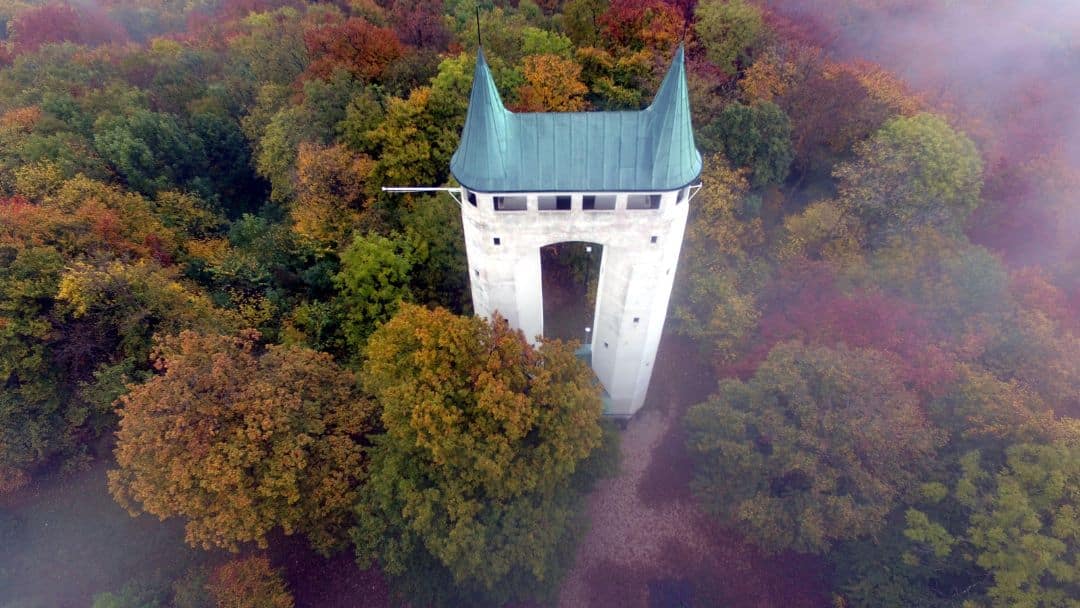
36. Sternberg Tower near Gomadingen
Far-reaching views from the highest peak of the Münsinger Alb
The Sternberg at 844 meters, is the highest peak in the Münsinger Alb and an extinct volcano. Its name is presumably derived from the seven valleys that cut into the steep slope in a star shape. Perched on its summit is the Sternberg Tower, which was built by the Gomadingen branch of the Swabian Albverein in 1912. After being destroyed in the Second World War, it was rebuilt in 1951. Today it offers a fantastic panoramic view over the Lauter valley, the Münsinger Alb and, on a clear day, as far as the Alps.
🥾 Hiking tip: You can reach the Sternberg Tower on foot from the hiking parking lot Braikestal approximately 20 minutes or from the Sternberg hiking parking lot in round 25 minutes. If you would like to go on a longer tour, I recommend the Premium hiking trail „hochgehsprudelt“ or the Planetary path both of which pass the Sternberg and offer a varied landscape.
💡 Extra Tip: In the immediate vicinity of Sternberg you will find two exciting excursion destinations - the traditional Main and State Stud Marbachthe oldest state stud farm in Germany, and the Grafeneck Castle, which today houses a documentation center and a memorial for the victims of Nazi "euthanasia". Both places can be easily combined with a visit to the Sternberg.
Parking: Hiking parking lot Braikestal (approx. 20 min.) or hiking parking lot Sternberg (approx. 25 min.)
37. Rutschenfelsen near Bad Urach
Spectacular view high above the Erms Valley
The Rutschenfelsen is one of the most impressive cliffs on the Albtrauf near Bad Urach. From here you have a breathtaking view directly onto the Hohenurach castle ruins and far across the Urach Alb. The rock owes its name to a historical peculiarity: at the neighboring Hanner Felsen, about two kilometers to the east, freshly felled trees were lowered down a long wooden chute into the valley until 1797.
🥾 Hiking tip: The best way to reach the Rutschenfelsen is from the Eppenzillfelsen hiking parking lot. From there, an approx. 1.2 km long path leads through the forest to the Rutschenfelsen. Ambitious hikers can walk the Waterfall trail, which also leads to the Urach and Güterstein waterfalls . However, this tour is challenging and only recommended for experienced hikers.
Parking: Hiking parking lot Eppenzillfelsen, 72574 Bad Urach
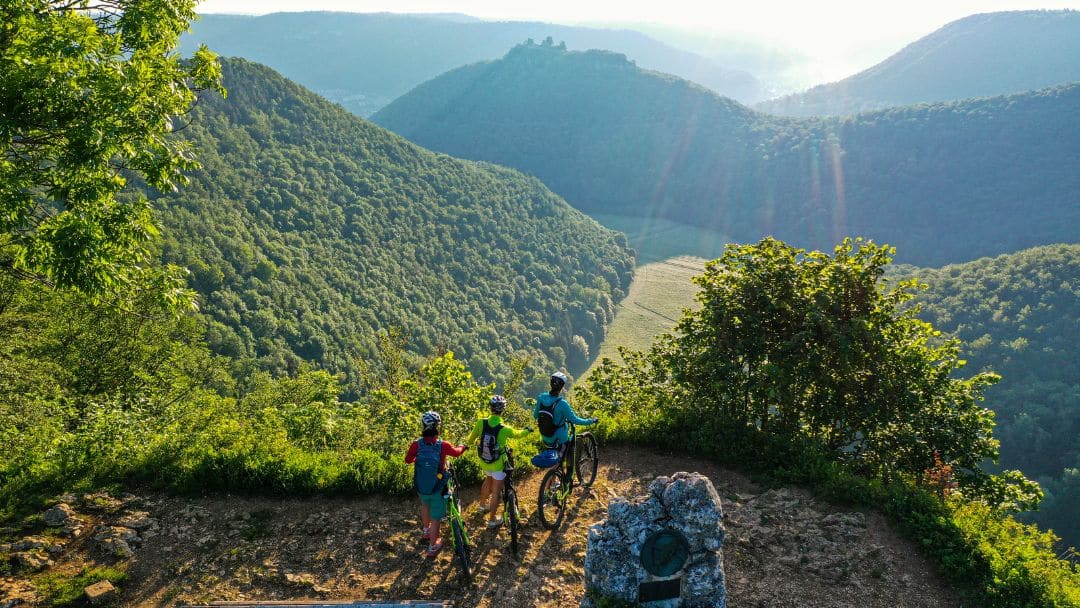
38. Lemberg Tower near Gosheim
View from the highest mountain in the Swabian Alb
The Lemberg is the highest mountain in the Swabian Jura at 1,015 meters - and therefore a must for anyone looking for the best views. Since 1899, the Lemberg Tower, a 33-metre-high steel observation tower. Its platform offers a magnificent panorama: you can see the Upper Danube Valley, the Black Forest, Lake Constance and even the Alps on a clear day. The tower is accessible free of charge all year round.
🥾 Hiking tip: The ascent begins at Lemberg hiking parking lot near Gosheim. From there you can reach the tower in about 45 minutes via a well-marked, moderately ascending path. If you prefer a more athletic hike, you can also include the Lemberg in a longer circular hike across the Upper Danube Valley.
💡 Extra Tip: The Lemberg is one of the "Ten thousand", the ten highest peaks in the Swabian Alb, all of which are over 1,000 meters. A visit is particularly worthwhile in the early morning or late evening - this is when the sunlight bathes the landscape in a unique atmosphere, and you can see the Alps on the horizon particularly clearly on beautiful autumn and winter days.
Parking: Hiking parking lot Lemberg, 78559 Gosheim
39. Knopfmacherfelsen near Fridingen
Panoramic view of the Upper Danube Valley
The Knopfmacherfelsen is one of the most famous vantage points in the Upper Danube Valley - and for good reason. Situated high above Beuron, it offers a spectacular view of the Danube, which winds its way through the steep limestone cliffs in narrow bends. The view of the Beuron Monasterywhich spreads out picturesquely on the valley floor.
🥾 Hiking tips:
- From Berghaus Knopfmacher you will reach the viewpoint in about 40 minutes, you walk another 40 minutes to the Danube Valley Memorial Temple, and back on the same trail.
- Another option is a easy circular hike from Fridingen: It passes several viewpoints, including the Knopfmacherfelsen, and takes around 2:10 hours.
💡 Special tip: Unforgettable is a sunrise tour from the Knopfmacherfelsen to the Danube Valley memorial temple. While the valley below you is still shrouded in mist, the silhouette of Beuron Abbey slowly emerges - one of the most beautiful sunrises in the entire Danube valley. To do this tour, it is a good idea to spend the night at Berghaus Knopfmacher.
Parking: In the Berghaus Knopfmacher, 78567 Fridingen an der Donau

Museums and Memorials in the Swabian Alb
From Ice Age art to the resistance against Hitler
The Swabian Alb not only offers nature experiences and panoramic views, but also a great cultural and historical diversity. In the museums, you can immerse yourself in prehistory and early history, experience everyday culture and get to know important personalities. The region's memorials, on the other hand, remind us of the dark chapters of the 20th century and of people who courageously stood up for their convictions.
Archaeological Museums in the Swabian Alb
The Swabian Alb is one of the richest archaeological sites in Europe - from the Ice Age to the Celts and the Romans. Three UNESCO World Heritage Sites characterize the region: the Caves and Ice Age Art in the Swabian Jurathe prehistoric Pile dwellings around the Alps at Federsee and the Upper Germanic-Raetian Limes. In the archaeological museums and open-air sites of the Swabian Alb, you can experience this evidence up close and take a journey back in time to the early history of Central Europe.
40. Museum of Ancient Cultures (Tübingen)
Ice age art and archaeological treasures at Hohentübingen Palace
At Museum Alte Kulturen (Museum of Ancient Cultures) of the University of Tübingen, housed in Hohentübingen Palace, contains world-class archaeological finds. Particularly significant are the original figurines from the Vogelherd Cave, near Niederstotzingen: a small horse and a mammoth made of mammoth ivory, which are among the oldest known works of art of mankind. Finds from the Pile-dwelling settlements on Lake Federsee to the collection, which represent the region's second UNESCO World Heritage Site.
The museum also presents objects from 40,000 years of cultural history - from the Stone Age to the Romans, supplemented by ancient Egyptian and oriental collections.
Museum of Ancient Cultures Info
Address: Hohentübingen Castle, Burgsteige 11, 72070 Tübingen
Opening hours: Wednesday to Sunday, 10:00 -17:00, Thursday 10:00 - 19:00
Admission: Adults approx. 5€, concessions approx. 3€ (as of 2025)
For further information, visit the Website of the Museum of Ancient Cultures.
41. Prehistoric Museum Blaubeuren (urmu)
UNESCO World Heritage and the oldest art of mankind
At Prehistoric Museum Blaubeuren you can marvel at spectacular original finds from the caves of the Swabian Alb, which have been part of the UNESCO World Heritage Site "Caves and Ice Age Art" are. The most famous exhibit is the 40,000-year-old Venus vom Hohle Felsthe oldest known female figure in the world. The collection is complemented by musical instruments and animal figurines made of mammoth ivory, which provide a unique insight into the culture of the Ice Age hunters.
Prehistoric Museum Blaubeuren Info
Address: Kirchplatz 10, 89143 Blaubeuren
Opening hours: Tuesday to Sunday, 10:00 -17:00 (closed on Mondays). Opening hours change in winter, please check the website before visiting.
Admission: Regular €6, reduced €5, children €3 (as of 2025)
For further information, visit the Website of the urmu.
42. Hauff Prehistoric World Museum (Holzmaden)
Fossils from the Jurassic Sea
The Hauff Primeval World Museum displays one of the world's most important collections of fossils from the Jurassic period. Around 180 million years ago, the Swabian Alb was covered by the primeval sea - exceptionally well-preserved fossils of ichthyosaurs, crocodiles, fish and marine plants have been preserved in the shale rock around Holzmaden. Many of the exhibits are unique and are presented in spectacular large specimens. A highlight for visitors is the opportunity to go to the nearby Primordial world of the Holzmaden quarry to search for fossils yourself - an experience that particularly delights families.
Urwelt-Museum Hauff Info
Address: Aichelberger Str. 90, 73271 Holzmaden
Opening hours: Tuesday to Sunday, 9:00 -17:00 (closed on Mondays). Opening hours change in winter, please check the website before visiting.
Admission: regular 8€, children 5€ (as of 2025)
For further information, visit the Website of the Urwelt-Museum Hauff
43. Limes Museum Aalen
UNESCO World Heritage Site and the largest Roman equestrian fort north of the Alps
The Limes Museum Aalen is located on the site of the largest known Roman cavalry fort north of the Alps. Here runs the Upper Germanic-Raetian Limes, which has been part of the UNESCO World Heritage belongs to. In the museum, you can learn all about Roman life on the frontier of the empire - from everyday objects and weapons to elaborate reconstructions. In the adjoining archaeological park, parts of the fort with walls and gates have been made visible again.
Limes Museum Aalen Info
Address: St.-Johann-Straße 5, 73430 Aalen
Opening hours: Tuesday to Sunday, 10:00 -17:00 (closed on Mondays)
Admission: regular 6€, reduced 4€ (as of 2025)
For further information, visit the Website of the Limes Museum Aalen
44. Heuneburg near Herbertingen
Celtic city and early Celtic center of power
The Heuneburg Castle near Herbertingen was one of the most important Celtic settlements in Central Europe around 2,500 years ago. Archaeological finds show that a real center of power existed here with trade links as far as the Mediterranean - probably identical to the city mentioned by Herodotus Pyrene. Today you can visit the Heuneburg Open-Air Museum visit reconstructed Celtic houses, fortifications and craft workshops and gain a vivid impression of everyday Celtic life.
🥾 Tip: Particularly exciting is the Archaeological circular trailwhich leads to several Celtic burial mounds. If you have less time, you can also visit the two mounds within sight of the Heuneburg - one of them is surrounded by a dry stone wall made of hewn square posts (reconstruction). Nearby is also the famous Hohmichele,one of the largest princely burial mounds in Central Europe. It can be reached on foot in just a few minutes from the hiking parking lot near Dollhofer Straße and is idyllically situated in the forest.
Heuneburg Info Info
Address: Heuneburg 1, 88518 Herbertingen
Opening hours: Tuesday to Sunday, 10:00 -17:00 (closed on Mondays)
Admission: regular €5, reduced €2.50 (as of 2025)
For further information, visit the Website of the Heuneburg
45. Federsee Museum Bad Buchau
UNESCO World Heritage Site of prehistoric pile dwellings
The Federsee Museum Bad Buchau is dedicated to the prehistoric pile-dwelling settlements on Lake Federsee, which are part of the UNESCO World Heritage Site "Prehistoric Pile Dwellings around the Alps" are. In the museum, you can find out how people lived in pile dwellings 6,000 years ago and see original finds such as tools, pottery and jewelry. In the adjoining outdoor area, you can enter reconstructed pile dwellings and immerse yourself in the world of the Stone and Bronze Ages. One of the most beautiful open-air museums I know - highly recommended and exciting for the whole family!
💡 Tip: Combine your visit to the museum with a walk along the Federsee footbridge, which takes you right into the heart of the nature reserve and offers fantastic views of the moorland and birdlife.
Federsee Museum Info
Address: August-Gröber-Platz 2, 88422 Bad Buchau
Opening hours: April to October daily 10:00 - 18:00, November to March only Sunday 10:00 -16:00 (as of 2025)
Admission: Adults €8, concessions €6.50 (as of 2025)
For further information, visit the Website of the Federsee Museum.
Museums on Culture, Everyday History and Traditions in the Swabian Alb
The Swabian Alb not only has ancient archaeological finds to offer, but also a rich cultural heritage. In this category, you will discover museums and institutions that showcase the everyday life of past centuries, the creativity of important personalities and the living traditions of the region - from rural culture and toy history to centuries-old horse breeding.
46. Museum Ulm
From Ice Age art to modern times
The Museum Ulm combines art and cultural history from many eras. It is particularly famous for the Löwenmensch, a figure carved from mammoth ivory, which was discovered around 40,000 years ago in the Stadel Cave in the Lone Valley was created. It is one of the oldest works of art known to mankind and is part of the UNESCO World Heritage Site "Caves and Ice Age Art of the Swabian Jura". The museum also exhibits collections medieval sculptures, works by Ulm masters such as Hans Multscher and modern art of the 20th century (including works by Picasso, the Blauer Reiter and Brücke artist groups and representatives of the Bauhaus).
Museum Ulm Info
Address: Marketplace 9, 89073 Ulm
Opening hours: Tuesday to Sunday, 11 a.m. - 5 p.m. (closed on Mondays)
Admission: Adults €8, concessions €6 (as of 2025)
Click here for the website of Museum Ulm.
47. Steiff Museum (Giengen an der Brenz)
The world of teddy bears and cuddly toys
The Margarete Steiff Museum is a must for families and anyone who loves toy history. In a modern world of experience, you can find out how the entrepreneur Margarete Steiff built up a world-famous toy empire despite having polio. At the heart of the exhibition are over 2,000 teddy bears and stuffed animals, including the first Steiff teddy from 1902who founded the triumphant advance of the cuddly toy. Interactive stations, imaginative scenes and a large play world make the visit an unforgettable experience, especially for children.
Steiff Museum Info
Address: Margarete-Steiff-Platz 1, 89537 Giengen an der Brenz
Opening hours: Monday to Sunday, 10 a.m. - 6 p.m. (as of 2025)
Admission: Adults €12, children €8 (as of 2025)
For further information, visit the Website of the Steiff Museum.
48. Beuren Open-Air Museum
Everyday culture from 600 years of history
At Beuren Open-Air Museum you will discover how people used to live and work in the Swabian Alb and the Neckarland region. Over 20 buildings from six centuries have been faithfully reconstructed on the extensive grounds - from the farmhouse to the village school and the mill. Authentic gardens, orchards and changing craft demonstrations make the tour a lively journey through time, which is particularly exciting for families.
Open-air museum Beuren Info
Address: In den Herbstwiesen, 72660 Beuren
Opening hours: End of March to beginning of November, Tuesday to Sunday 9 am - 6 pm (closed on Mondays, except public holidays)
Admission: Adults €8.50, children €4.50 (as of 2025)
For further information, visit the Website of the Beuren Open-Air Museum.
49. Main and State Stud Marbach
Living horse tradition since the 16th century
The Main and State Stud Marbach near Gomadingen is the oldest state stud farm in Germany and is considered a living cultural monument of the Swabian Alb. Noble horses have been bred here since the 16th century, including the famous thoroughbred Arabian horses from the Marbach line. Visitors can explore the extensive stables and pastures, experience stallion parades or foal demonstrations and gain an insight into the centuries-old tradition of horse breeding on guided tours. The location of the stud farm in the idyllic Great Lauter Valley, which is one of the most beautiful landscapes in the Swabian Jura.
💡 Tip: Only a few kilometers away from the stud farm is the Gomadingen-Offenhausen founded the Stud Museumwhich offers exciting insights into the history of horse breeding in the Swabian Alb. The Lauter springs directly next to the former Offenhausen monastery, which houses the stud museum. The museum and the Lauter spring are stops on the scenic premium hiking trail "bubbled up"on which you can see the Sternberg with the observation tower and the Lauter Valley.
Main and State Stud Marbach Info
Address: Gestütshof 1, 72532 Gomadingen-Marbach
Opening hours: Guided tours of the stud farm from April 1 to October 31 on all Sundays and public holidays and during the Baden-Württemberg Easter, Whitsun, summer and fall vacations daily at 1:30 pm and 3:00 pm. From November 1 to March 31 on all Sundays and public holidays and during the Baden-Württemberg Christmas and winter vacations daily at 1:30 pm. You can find current information to my newsletter.
Admission: Adults €7, children €3.50 (as of 2025)
For further information, visit the Website of the Marbach Stud Farm.
Memorials in the Swabian Alb: Places of Remembrance Culture
The Swabian Jura is not only rich in castles and natural monuments, but also a place of remembrance. Several memorials commemorate the victims of Nazi crimes and pay tribute to the courage of people who resisted Hitler. Travelers will not only find beautiful views and historic walls, but will also be reminded of the responsibility to keep history alive. These places invite you to pause and understand the past not just as an abstract chapter, but in personal stories and haunting locations.
50. Grafeneck Memorial (Gomadingen)
Remembering the victims of Nazi "euthanasia"
In 1940, on the grounds of Schloss Grafeneck near Gomadingen, 10,654 people with cognitive and mental disabilities were murdered as part of the Nazi "euthanasia" program. This made Grafeneck the first of a total of six central killing centers in the German Reich. Today a Memorial site reminds of the victims of this place of horror.
The stories of suffering of the victims and their families are vividly traced in the documentation center. At the Memorial site an open chapelthe the Book of Names and Remembrance , and the Alphabet Garden invite you to pause for a moment. It is particularly moving that the castle grounds are once again used as a facility for people with disabilities - a conscious sign against exclusion and forgetting.
Grafeneck Memorial Info
Address: 72532 Gomadingen-Grafeneck
The memorial is well signposted. There is a visitor parking lot diagonally opposite the documentation center.
Opening hours: March 31 to October 6: daily 9 a.m. to 6 p.m., October 7 to March 30: daily 10 a.m. to 4 p.m. (until 5 p.m. during Advent)
Admission: free (as of 2025)
For further information, visit the Website of the Grafeneck Memorial.

51. Stauffenberg Memorial (Lautlingen)
Childhood home of the conspirator of July 20, 1944
The exhibition documents the history of the family, the life of Claus Schenk Graf von Stauffenberg and the events surrounding the assassination of the July 20, 1944. Original documents, photos and personal items paint the picture of a man who went from being a convinced officer to a resistance fighter. His fate was fulfilled in the Bendlerblock in Berlin, where he was executed after the failed assassination attempt - a place that is now also accessible as a memorial.
Stauffenberg Memorial Info
Address: Schloßbergstraße 59, 72459 Albstadt-Lautlingen
Opening hours: Wednesday, Saturday and Sunday 14:00 -17:00 (as of 2025)
Admission: regular 3€, reduced 2€ children up to 18 years free (as of 2025)
For further information, visit the Website of the Stauffenberg Memorial.
52. Georg Elser Memorial (Königsbronn)
The man who almost stopped Hitler
The Georg Elser Memorial in Königsbronn commemorates the journeyman carpenter Georg Elser, who carried out an assassination attempt on Hitler in Munich's Bürgerbräukeller on November 8, 1939. The assassination attempt only failed because Hitler left the room earlier than planned. Elser was arrested soon, and murdered in Dachau concentration camp in 1945.
The memorial is located in the former town hall of Königsbronn, Elser's home town. Documents, photos and original objects trace the life of an ordinary man who recognized the catastrophe caused by the Nazi regime early on - and was prepared to stand up to it alone
Georg Elser Memorial Info
Address: Herwartstraße 2, 89551 Königsbronn
Opening hours: Sundays and public holidays: 11:00 to 17:00. Guided tours can also be arranged outside opening hours (Tel. 07328 9625-10).
Admission: regular 3€, pupils 14 - 17 years 1€, children free (as of 2025)
Click here for the website of the Georg Elser Memorial.
Practical Tips for Your Trip to the Swabian Alb
Getting to the Swabian Alb
The Swabian Alb covers a large area between Tübingen, Ulm, Aalen, and the Upper Danube Valley. The best way to get there therefore depends on which part of the region you plan to visit. For a road trip and for reaching many of the natural attractions, castles, and viewpoints featured in this article, you will have the greatest flexibility with your own car or a rental car.
By Car
The Swabian Alb is easily accessible from all directions via Germany's highway network. The A8 runs from Stuttgart across the Swabian Alb to Ulm and is particularly convenient for destinations around Kirchheim unter Teck, Bad Urach, Blaubeuren, and Ulm. The A7 provides access to the eastern Swabian Alb around Aalen, Heidenheim, and Giengen. The A81 runs west of the region and is a good route for reaching Tübingen, Hechingen, Balingen, and Rottweil.
Away from the highways, federal and state roads cross the Alb plateau and wind through its valleys. Allow a little more driving time than the distances may initially suggest: Some roads are winding, and many attractions are located outside the towns. On the plus side, the views from the Albtrauf escarpment and the drives through quiet valleys are already part of the travel experience.
By Train
The Swabian Alb is also relatively easy to reach by train. Tübingen, Bad Urach, Ulm, Blaubeuren, Aalen, and Sigmaringen are particularly suitable bases for a car-free stay. From there, regional trains and buses take you to many smaller towns and vacation destinations. However, some remote castles, caves, and viewpoints are difficult to reach by public transportation or require longer walks from the nearest stop. A rental car is therefore the more convenient option if you would like to combine as many of the 52 highlights as possible.
💡 Tip: When you stay with a participating AlbCard accommodation provider, you can travel throughout the region by bus and train free of charge during your stay. This even includes local public transportation in Ulm and Neu-Ulm.
👉 You can find more information on the Getting Here page of the Swabian Alb Tourism Association..
By Plane
For the western and central parts of the Swabian Alb, the nearest major airport is Stuttgart Airport. The rental car companies are conveniently located in Terminal 1 on the arrivals level. From the airport, the A8 provides quick access toward Reutlingen, Bad Urach, Kirchheim unter Teck, and Ulm.
Depending on available flight connections, Munich, Memmingen, or Nuremberg airports may also be convenient for destinations in the eastern Swabian Alb and around Ulm. Since distances within the region can be considerable, it is worth deciding which parts of the Swabian Alb you would like to explore before booking your flight.
My tip: If you are traveling from farther away or from abroad, consider combining your trip with one or two days in Stuttgart, Tübingen, or Ulm. All three cities make excellent starting or ending points for a tour of the Swabian Alb and are well worth exploring in their own right.
Arriving via Frankfurt
For international travelers flying into Germany, Frankfurt Airport is often the first major hub. My Frankfurt Airport Guide has everything you need for a smooth arrival and onward journey.
Where to stay in the Swabian Alb? My Hotel Tips for Your Stay
The Swabian Alb offers many charming accommodations - from modern city hotels to traditional country inns. For travelers who appreciate comfort and authenticity, it is worth choosing a location based on personal interests. Here are three recommendations:
Karls Hotel, Sigmaringen - Modern hotel directly on the Danube with a view of the Hohenzollern Palace.
Forellenhof Rössle, Lichtenstein-Honau - Traditional country inn with regional cuisine, ideal for a visit to Lichtenstein Castle.
Domicile, Tübingen - pleasant hotel in a prime location directly on the Neckar and just a few steps from the old town, perfect for city explorers.
Travel Guide Recommendations for the Swabian Alb
For my own explorations, I used these travel guides, both of which I can highly recommend:
Jürgen Meyer: 101 Highlights Schwäbische Alb (Oertel + Spoerer Verlag) - Well-structured and inspiring, ideal for a quick overview of the most beautiful destinations. With lots of useful tips on hikes, accessibility and places to stop for refreshments.
Markus Bingel, Lars Dörenmeier: Schwäbische Alb (Trescher Verlag) - detailed, with lots of background information on history, culture and nature. Great tips for hiking and cycling tours.
Frequently asked questions about the Swabian Alb
What is the best time to visit the Swabian Alb?
The Alb is particularly beautiful in the autumn when the forests and landscape glow in bright colors. Also Spring (flowering time) and Summer (festivals, open-air stages) are worthwhile.
What is the AlbCard and how do I get it?
Overnight guests receive the following in many accommodations AlbCard free of charge from the first overnight stay. This gives you free admission to over 180 attractions in the Swabian Alb, such as Lichtenstein Castle, Hohenzollern Castle Sigmaringen, Heuneburg Castle - City of Pyrene, Bear and Fog Cave and many more.
Which UNESCO World Heritage Sites are located in the Swabian Alb?
You can experience three UNESCO World Heritage Sites on a trip across the Alb: The Caves and Ice Age Art in the Swabian Jura can be explored at the sites in the Ach and Lone valleys. The finds are on display in museums in Blaubeuren, Tübingen and Ulm. The prehistoric Sites at Federsee are part of the UNESCO World Heritage Site "Prehistoric Pile Dwellings around the Alps". At the Limes Museum in Aalen, you can immerse yourself in the world of the Romans at the Upper Germanic-Raetian Limes immerse yourself.
Which specialties should you try in the Alb?
Typical are Spaetzle (e.g. with lentils and string sausages), Maultaschen and hearty game dishes. Many inns still cook according to traditional recipes.
Is the Swabian Jura also worth a longer vacation?
Yes, cities like Tübingen, Ulm or Blaubeuren can be perfectly combined with hikes, castles or museums. Also for Road Trips the Alb is ideal.
What wellness offers are there in the Swabian Alb?
In health resorts like Bad Urach or Bad Überkingen you will find thermal spas and mineral baths. Many hotels combine wellness with regional cuisine and nature experiences.
Is it possible to travel the Swabian Alb without a car?
Yes, larger cities like Tübingen, Ulm or Hechingen can be reached by train. Buses run from there to many destinations. However, you are more flexible with a rental car or e-bike.
Which hikes are suitable for less experienced hikers?
Many viewpoints can also be reached via short routes, e.g. the Zeller Horn (20 minutes) or the Breitenstein (10 minutes). So you can enjoy the panoramas without a long tour. Castles and palaces usually have their own parking lot or shuttle service.
What must I definitely see in the Swabian Alb?
Absolute must-sees are Hohenzollern Castle and Lichtenstein Castle as well as Tübingen, Ulm and the Urach Waterfalls.
Conclusion: An Underestimated Region with Great Diversity
The Swabian Alb is one of the most diverse landscapes in Germany - and yet still unknown to many. Between cliffs, caves, castles, half-timbered towns and monasteries, you will find a density of natural and cultural treasures that you will hardly find in any other region.
It is precisely because the Alb is often underestimated that a visit is particularly worthwhile: you can still discover many highlights in peace and quiet, away from the crowds of tourists. Anyone who comes here quickly realizes that the Swabian Alb belongs at the top of every German bucket list.
Further Reading
If browsing through this article has whetted your appetite for a road trip across the Swabian Alb, you will find two route suggestions for this varied region in my article Road Trip Germany - The Most Beautiful Routes with Highlights and Map,.
To these places on the Swabian Alb you can find further articles on my blog: Tübingen, Kirchheim unter Teck, Rottweil, Sigmaringen and Inzigkofen Princely Park, Grafeneck Memorial and the surrounding area.
If you are visiting the Swabian Alb, a visit to the Baden-Württemberg's state capital Stuttgart which is absolutely worth seeing and can be reached quickly. You can find an overview of Stuttgart's highlights in my article about The Most Beautiful Cities in Germany. In further contributions you will find Tour of Stuttgart city center and to Stuttgart's most beautiful viewpoints between the television tower and Weißenburgpark.
For travel planning, my comprehensive guide to the 52 most beautiful regions in Germany an overview of the country's most beautiful vacation regions. The Swabian Alb is of course also included!
Inspiration for your next excursion, vacation or short trip can be found in the article Destination Germany - The Ultimate List of the 100+ Most Beautiful Places.
In my article about Germany's 55 UNESCO World Heritage Sites you can find more information about the UNESCO World Heritage Sites around the Swabian Alb (Cave and Ice Age art of the Swabian Alb, Prehistoric Pile Dwellings around the Alps and Borders of the Roman Empire - the Upper German-Rhaetian Limes).
Where to go next long weekend?
My free guide Germany. 12 Escapes. takes you through 12 travel regions in Germany — from the North Sea coast to the Alps. For each region: the best time to visit, 5 concrete highlights, and my personal tip from first-hand experience.
No research rabbit hole, no endless browser tabs — just get in the car and go.
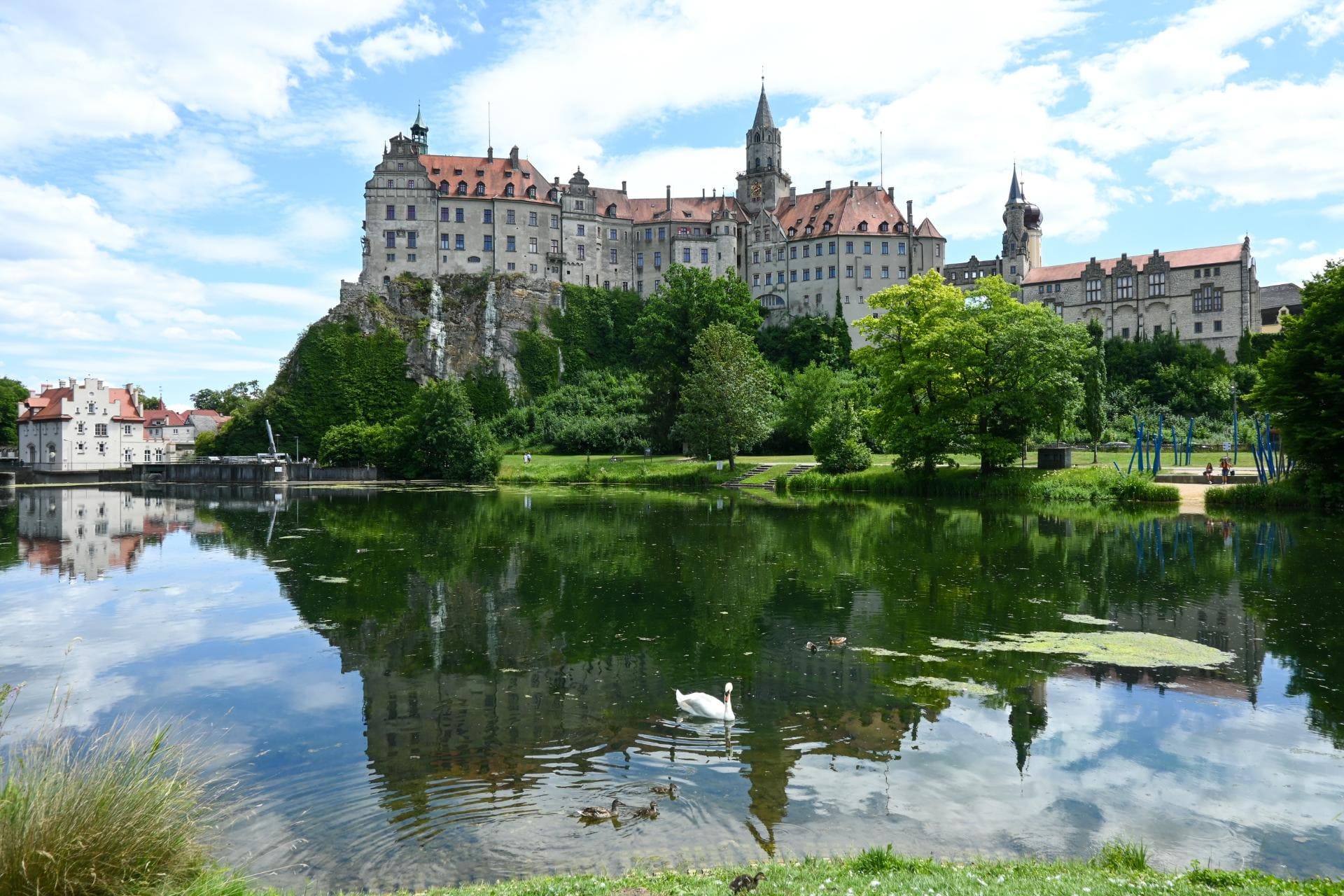
For a few days now, I've been exploring the Swabian Alb and discovering corners that are still unknown to me. Although read more
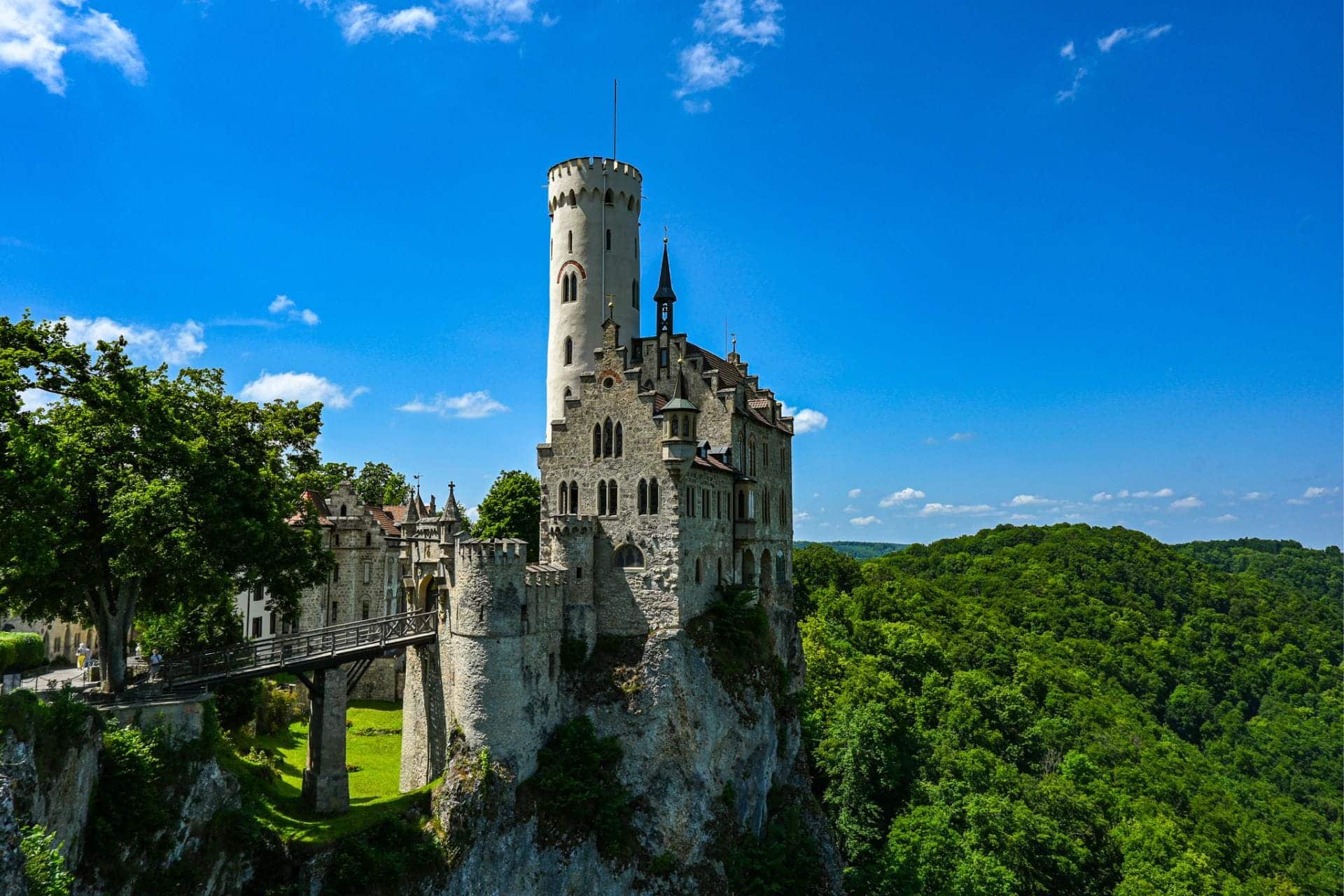
Lichtenstein Castle has a nickname that is by no means an exaggeration: the „fairy-tale castle of the Swabian Alb." Anyone visiting for the first time via the read more
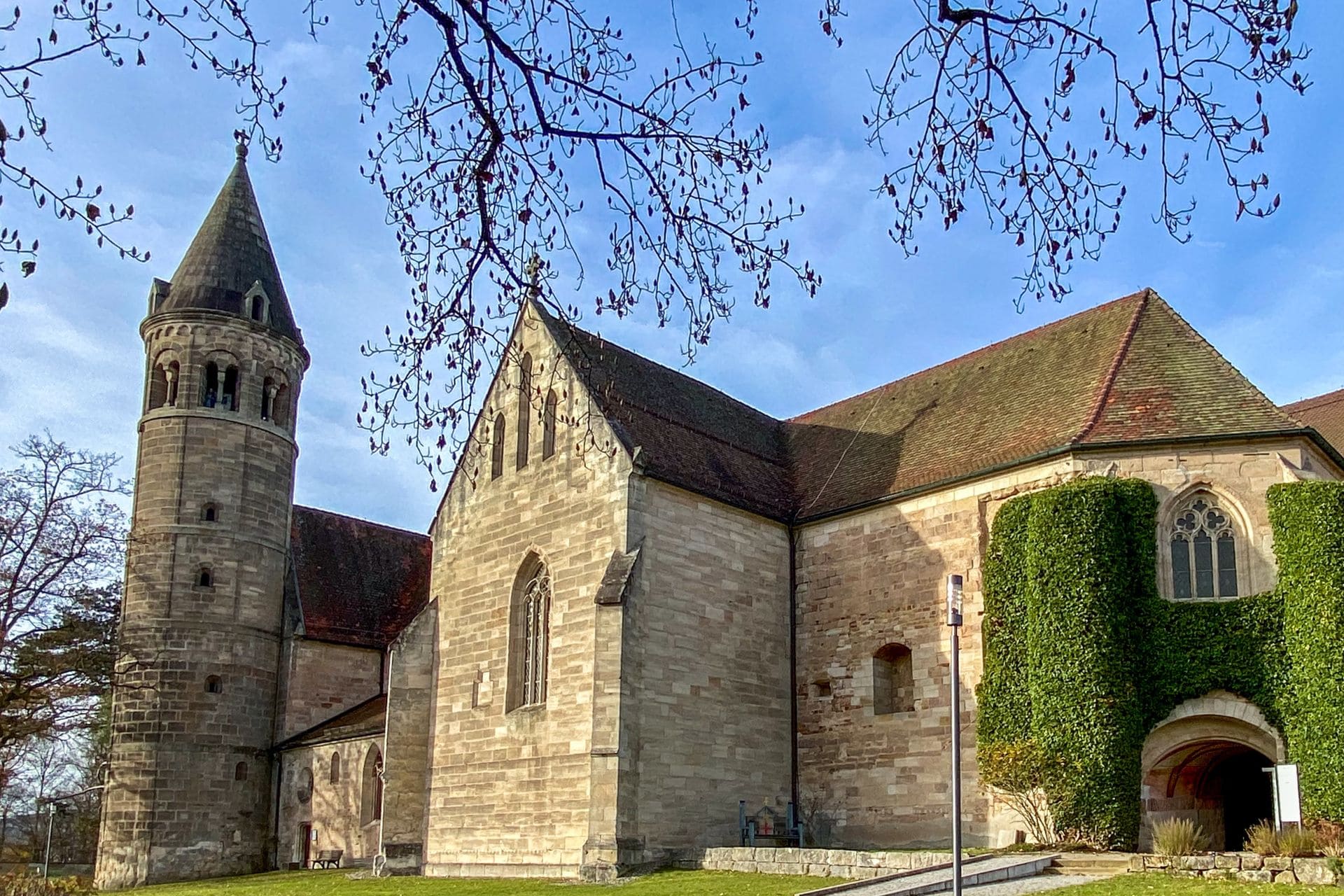
15 degrees and sunshine inspired me to take a trip to Stauferland today, between Göppingen and Schwäbisch Gmünd - an area read more
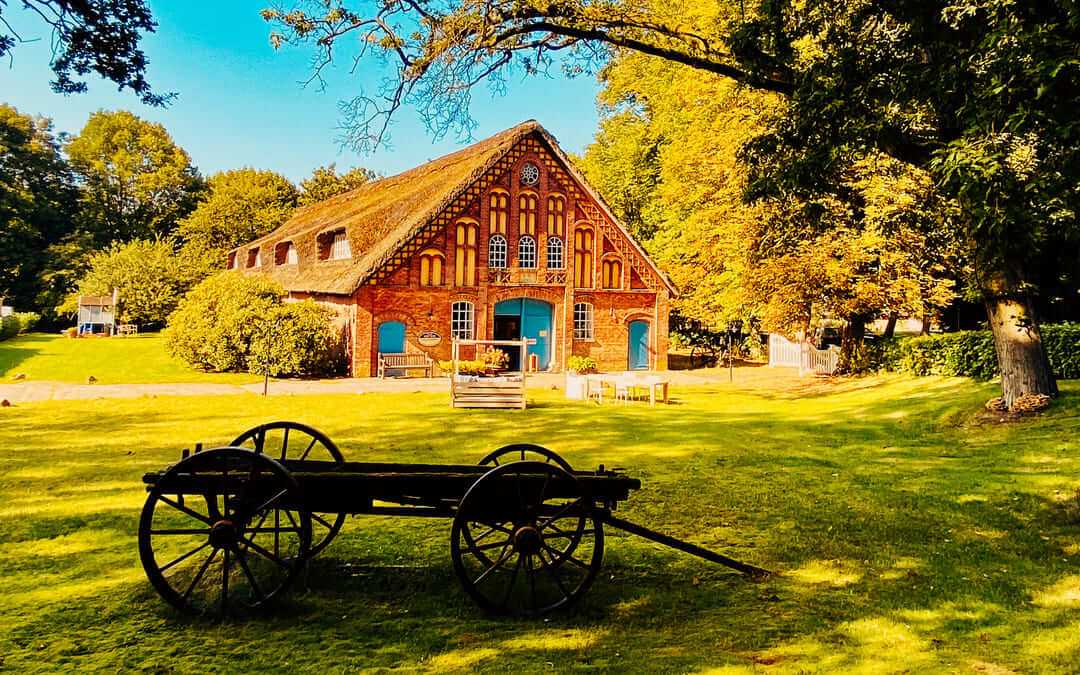
Germany is perfect for a road trip: well-maintained roads, a variety of landscapes, exciting cities and plenty of culture and cuisine read more

About me: I love to travel, write and photograph - preferably in places where the past is visible. Whether it's half-timbered towns, castles or quiet landscapes - there's something in every place that touches you and inspires you to think further. With my blog Angie's Travel Routes I would like to inspire you to discover Germany on your own. I share my experiences, personal impressions and practical route tips to make your next trip a special experience.
You can find out more about me to my newsletter.

 Deutsch
  English
0 Comments
Trackbacks/Pingbacks